What does a sales enablement director do?
A sales enablement director builds and manages the systems, programs, and content that help sales teams perform better. This typically includes onboarding, training, coaching, certifications, content alignment, and performance analytics. In a mid-size enterprise, the role often expands to proving training ROI, improving rep readiness, supporting managers with coaching data, and aligning enablement efforts to pipeline growth, win rates, and revenue outcomes.
What skills are most important for a Sales Enablement Director in a mid-size enterprise?
The strongest candidates combine strategic planning with operational execution. Key skills include sales training design, coaching program development, content governance, stakeholder alignment, analytics, and change management. In mid-size enterprises, directors also need to evaluate technology carefully, reduce tool sprawl, and build scalable processes that support growth without requiring large enablement teams or heavy administrative overhead.
How is a mid-size enterprise enablement role different from an enterprise role?
Mid-size enterprise roles usually require broader ownership with fewer dedicated resources. A director may oversee onboarding, certifications, content strategy, manager coaching, and reporting all at once. Unlike larger enterprises with specialized teams, mid-size organizations often need one leader to create scalable systems, show measurable impact quickly, and choose platforms that combine multiple capabilities instead of relying on several separate tools.
What metrics should a Sales Enablement Director track?
Important metrics include ramp time, certification completion, training adoption, call quality, content usage, win rates, pipeline progression, and deal cycle length. The most effective directors also connect learning activity to business outcomes such as revenue growth, fewer support escalations, and improved rep consistency. Tracking both readiness metrics and revenue metrics helps demonstrate that enablement is influencing actual sales performance.
What tools are commonly used in sales enablement leadership roles?
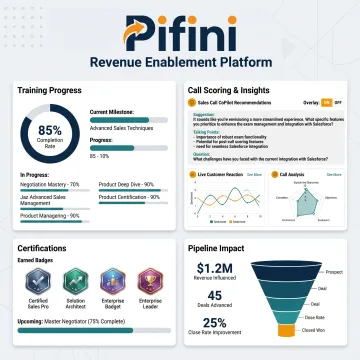
Sales enablement directors often manage learning platforms, content systems, call coaching tools, analytics dashboards, and CRM-connected workflows. Increasingly, mid-size enterprises prefer unified platforms that combine LMS functionality, AI coaching, call scoring, roleplay, and buyer engagement tools. This approach reduces administrative complexity, improves data visibility, and makes it easier to connect training activity with rep behavior and revenue outcomes.
How can a Sales Enablement Director prove ROI?
ROI is best demonstrated by linking enablement activity to measurable business results. That includes correlating training completion, certifications, coaching sessions, and call performance with win rates, pipeline growth, and closed deals. Directors who use analytics to show which programs improve readiness and which behaviors influence outcomes can make a stronger business case for budget, headcount, and continued investment in enablement.
What should mid-size enterprises look for in an enablement platform?
Mid-size enterprises should prioritize platforms that are scalable, easy to administer, and capable of combining multiple functions in one system. Useful capabilities include onboarding, certifications, AI coaching, call scoring, analytics, and integrations with CRM or partner systems. Transparent pricing also matters. A platform that reduces vendor sprawl while giving leaders clear visibility into readiness and revenue impact is usually the strongest fit.
Can sales enablement support channel and partner teams too?
Yes. Many mid-size enterprises rely on indirect revenue through resellers, distributors, or alliance partners, so enablement often extends beyond internal reps. A strong enablement strategy can include partner onboarding, certification tracking, compliance training, AI coaching, and centralized content delivery. When partner teams receive the same structured support as direct sellers, organizations typically see better consistency, adoption, and sales execution across the ecosystem.