Introduction
Most sales training fails to stick because it's passive, reps watch a PowerPoint, listen to a lecture, and promptly forget 87% of it within 30 days. Sales roleplay exercises change this by putting reps in the moment before the moment counts, letting them practice discovery calls, objection handling, and negotiation in a controlled environment where mistakes cost nothing.
Roleplay is rarely run consistently enough to produce lasting improvement. That gap shows up in longer ramp times, inconsistent win rates, and unpredictable deal outcomes, particularly in distributed organizations and partner ecosystems where managers can't reach every rep.
This article covers why roleplay produces measurable results, not just confidence, which scenarios matter most, and how AI-powered platforms now make always-on practice possible without scheduling a single manager.
Key Takeaways
- Roleplay simulates real buyer conversations so reps refine skills without risking live deals
- Biggest advantages: faster ramp time, consistent objection handling, and stronger performance across distributed teams
- Highest-value scenarios: discovery calls, objection handling, negotiation, and competitive positioning
- Skip roleplay and teams default to costly on-the-job learning that's inconsistent and hard to scale
- AI-powered platforms enable scalable, personalized roleplay with real-time feedback, no scheduling required
What Are Sales Roleplay Exercises?
Sales roleplay exercises are structured practice simulations in which a rep acts out a sales scenario, typically with a manager, peer, or AI counterpart playing the buyer, to rehearse real selling moments before they happen in live deals. The goal isn't to complete an exercise but to change how a rep behaves in the next real conversation.
Roleplay is used across multiple contexts:
- New hire onboarding and ramp acceleration
- Ongoing coaching sessions and skill development
- Pre-deal preparation for high-stakes opportunities
- Product launch readiness and messaging alignment
- Partner and channel sales training for distributed ecosystems
Think of roleplay as a performance system, not a training event. Top-performing sellers don't memorize scripts, they practice real conversations until the right responses come automatically, even when buyers push back hard.
Key Advantages of Sales Roleplay Exercises
The advantages below tie directly to outcomes sales leaders track: ramp time, win rates, deal consistency, and revenue predictability.
Advantage 1: Faster Sales Onboarding and Rep Ramp Time
Roleplay compresses the learning curve by replacing passive instruction with active repetition. Reps internalize messaging, questions, and responses through doing, not observation alone. Research shows that active practice yields 75% knowledge retention compared to just 5% from passive lectures.
How this works in practice:
New hires run structured scenarios, discovery calls, elevator pitches, objection handling, repeatedly until their responses become instinctive. Rather than discovering the right approach through lost deals, they refine it through controlled practice.
Why this is an advantage:
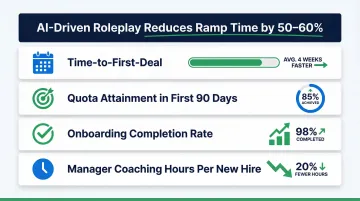
The cost of a slow-ramping rep is compounded. The average B2B sales rep takes 5.3 to 5.7 months to reach full productivity, with each month of excess ramp time costing approximately $10,000 to $15,000 per rep in unrealized pipeline. Organizations implementing AI-driven roleplay simulations report reducing ramp time by 50-60%, cutting onboarding from 210 days to just 72 days .
Faster ramp translates to reduced management burden, lower onboarding costs, and earlier revenue contribution, critical for organizations scaling into new markets or partner ecosystems where reps must learn more before they can sell effectively.
KPIs impacted:
- Time-to-first-deal
- Quota attainment in first 90 days
- Onboarding completion rate
- Manager coaching hours per new hire
When this advantage matters most:
High-growth teams adding reps quickly, companies entering new verticals, and organizations with complex products or partner-dependent sales motions.
Advantage 2: Consistent Objection Handling and Deal Control
Objection handling is the single most variable skill across a sales team. Without structured practice, responses differ widely by rep, creating unpredictable deal outcomes and revenue leakage.
Roleplay addresses this by surfacing the top 5-10 objections buyers actually raise, building scenarios around them, and giving every rep a practiced, tested response before it counts.
Why this is an advantage:
Gong's analysis of 326,000 sales calls found that high performers maintain the same talk-to-listen ratio whether they win or lose, while low performers' talk time swings by 10% when deals are lost, from 54% in won deals to 64% in lost deals, indicating they react defensively rather than controlling the conversation.
When reps have practiced responses, they spend less cognitive energy on what to say and more on reading the buyer, building rapport, and guiding the conversation toward close. Top-performing salespeople are 64% more likely to be experts at reframing buyer objections compared to average sellers.
KPIs impacted:
- Close rate
- Average deal cycle length
- Objection-to-conversion ratio
- Rep-to-rep performance variance
When this advantage matters most:
Competitive markets with multiple alternatives, high-volume inside sales environments, and distributed teams (including resellers and channel partners) where message consistency is difficult to enforce without scalable training systems.
Advantage 3: Performance Consistency Across Distributed Teams and Partner Ecosystems
For organizations with distributed teams, remote reps, or partner ecosystems, performance consistency is the hardest problem to solve. What the top rep knows instinctively, the bottom rep doesn't even know they're missing.
Structured roleplay closes that gap. Standardized scenarios ensure every rep, whether a direct hire or reseller partner, has practiced the same critical conversations and received feedback before going live with buyers.
Why this is an advantage:
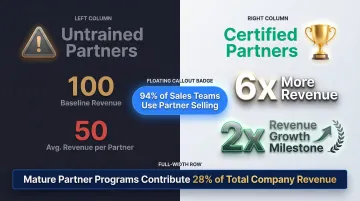
Inconsistent partner or rep messaging directly damages brand credibility and buyer trust. While 94% of sales teams use partner selling, there's a massive performance gap: certified partners earn 6x more revenue than untrained partners, and mature partner programs drive 2x revenue growth while contributing 28% of total company revenue.
When roleplay is systematized rather than left to individual managers, organizations can grow headcount or partner networks without proportionally increasing coaching overhead. This scalability matters because manager bandwidth is already stretched, frontline managers spend 30-60% of their time on administrative tasks, leaving only 10-40% for actual coaching.
KPIs impacted:
- Cross-team win rate variance
- Partner-sourced revenue
- Average deal size by team/region
- Training completion and certification rates
When this advantage matters most:
Organizations running partner, reseller, or distributor channels; geographically distributed sales teams; and companies where sales enablement must scale beyond what individual managers can personally coach.
Essential Sales Roleplay Scenarios for Your Team
The most effective scenario library covers the full sales conversation arc, from first touchpoint through negotiation, so reps have rehearsed every critical stage, not just the ones they're most comfortable with.
Discovery Call
This is the highest-leverage scenario to practice because a poor discovery call, vague questions, failure to identify real pain, corrupts every downstream conversation. In closed-won deals, reps talk for 57% of the time compared to 62% in lost deals, showing that top performers listen more and probe deeper.
Reps should practice probing past surface-level answers to uncover decision drivers. The sweet spot is asking 11-14 targeted questions, asking too many feels like an interrogation, while too few fails to unearth sufficient pain points.
Objection Handling
This scenario should be run with the actual objections your team hears most, pricing pushback, incumbent vendor loyalty, "we're not ready yet." Reps develop tested, personalized responses rather than generic deflections. Repeated practice builds automatic, confident responses, so reps can navigate social friction and deliver clear messaging under pressure without hesitating.
Negotiation
This scenario teaches reps to defend value before discussing price, explore alternatives to discounting, and stay composed when buyers apply pressure or reference competitor pricing. The data makes the stakes clear:
- Successful deals almost always carry lower average discounts than lost ones
- Organizations with formalized pricing governance achieve 30% higher profit margins
This matters most for teams handling complex, multi-stakeholder deals where discount pressure compounds across multiple decision-makers.
Competitive Positioning
This underused scenario prepares reps to answer "Why not Competitor X?" without going negative, focusing on differentiators tied to the buyer's specific priorities and using proof points (case studies, references) to anchor the comparison.
In crowded markets, buyers always arrive with alternatives already shortlisted. That complexity is growing: the typical B2B buying decision now involves 13 internal stakeholders and 9 external influencers. When that many people are evaluating competitors simultaneously, reps who can't articulate clear, context-specific differentiation lose the room. Multi-threading boosts win rates by 130% in deals over $50K, but only when each stakeholder hears a positioning story that speaks to their priorities.
What Happens When Sales Roleplay Is Missing or Ignored
Skip structured roleplay and the same failure patterns surface, reliably, repeatedly, and at scale:
- Reps learn on live deals. Every real conversation becomes a training session at the buyer's expense, producing inconsistent outcomes and longer sales cycles. Currently, 47% of reps report they don't get enough roleplay practice before customer calls, and 46% rarely receive feedback.
- Objection handling and messaging vary rep to rep. Without roleplay data, managers can't tell whether underperformance is a skill gap, a process gap, or a motivation gap, and each requires a completely different fix. Guessing costs time and deals.
- Onboarding stretches out, and manager time gets consumed. Reactive deal coaching replaces proactive skill-building, which caps a manager's ability to scale performance as headcount grows.
The result: underperformance that looks like a people problem is often a preparation problem, one that structured practice directly solves.
How to Get the Most Value from Sales Roleplay Exercises
Roleplay works best when it's structured and specific. Each session should have one defined objective, handling a pricing objection, delivering a clean discovery call, a realistic scenario drawn from actual buyer conversations, and a structured debrief that surfaces both what worked and what to change next time.
Consistency matters more than frequency or duration. 15-minute roleplay sessions embedded in weekly 1:1s or team meetings build habits more effectively than quarterly half-day training events. Outcomes compound when practice is regular, not episodic.
For teams scaling across distributed sales organizations or partner ecosystems, AI-powered platforms like Pifini enable on-demand roleplay simulations without depending on a manager's availability. Reps get real-time feedback, automated scoring, and targeted training routed directly to them when skill gaps surface.
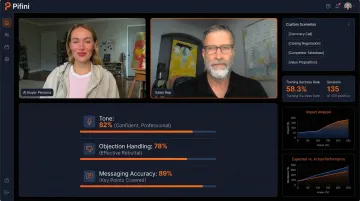
Pifini's Sales Roleplay feature lets sellers and partners practice discovery calls, objection handling, and closing conversations against AI-driven buyers that mirror real customer interactions. Instant scoring covers:
- Tone and clarity
- Objection handling technique
- Messaging accuracy against your playbook
- Custom scenarios built from uploaded battlecards and industry-specific content
Organizations can run this across geographically distributed teams and partner networks at $50 per user per year, a fraction of what legacy enablement platforms charge.
Frequently Asked Questions
What is role play in sales?
Sales roleplay is a structured practice method where a rep acts out a simulated sales conversation, typically with a manager, peer, or AI acting as the buyer, to rehearse key scenarios like discovery calls, objection handling, or negotiations before they occur in live deals.
How do you do a sales roleplay?
An effective sales roleplay involves defining a specific scenario (for example, a prospect raising a pricing objection), assigning clear roles, running the simulation, and following it with a structured debrief. That debrief covers what worked, what didn't, and one concrete thing to improve next time.
What are some good sales roleplay scenarios?
Discovery calls, objection handling, negotiation, competitive positioning, elevator pitch, and stalled deal reactivation are the highest-value scenarios. The best scenarios are built from actual objections and conversation patterns your team encounters most often, not generic templates.
How do I get good at sales roleplay?
Improvement comes from repetition and targeted feedback. Focus on one skill per session, practice the same scenario multiple times, and ask for specific coaching, not general critique, until the response feels natural.
How do you introduce yourself in a sales roleplay?
A strong opening mirrors real life, start with a brief, confident introduction, establish relevance quickly (why are you calling/meeting?), and immediately pivot to a question that puts the focus on the buyer's situation rather than the rep's pitch.
What is a roleplay scenario for sales interviews?
Sales roleplay interview scenarios ask candidates to act out a cold call, product pitch, or objection-handling situation. Interviewers evaluate confidence, question quality, and listening skills, not whether the candidate closes a fictional deal.