Introduction
Most sales teams measure activity, calls made, emails sent, pipeline value, yet these surface metrics never explain why deals move forward or why they stall. 76% of CRM entries are less than half complete, and sales managers review less than 1% of all calls, making performance improvement largely reactive and guesswork-driven. Without visibility into what actually happens during customer conversations, revenue leaders are left improving the wrong things.
Conversational analytics moves teams from activity tracking to conversation intelligence, AI-powered analysis that transforms every sales interaction into structured, actionable data. Instead of relying on manager intuition or random call sampling, it surfaces objections, sentiment shifts, buyer intent, and deal risk hidden inside every call. Those insights then route directly into targeted coaching that actually changes behavior.
Key Takeaways
- Conversational analytics uses AI and NLP to transcribe, analyze, and score sales conversations, catching objections, sentiment shifts, and deal risk that pipeline metrics miss
- Sales teams gain evidence-based coaching and pipeline visibility rather than relying on manager intuition alone
- The real value is detecting patterns across hundreds of conversations and routing those insights into immediate action
- For partner ecosystems, conversational analytics provides visibility into distributed sales conversations leadership rarely sees
- Connecting call insights to structured training is what separates teams that collect data from teams that get better
What Is Conversational Analytics for Sales?
Conversational analytics captures, transcribes, and analyzes spoken and written sales interactions, calls, video meetings, chat, and messaging, using AI, NLP, and machine learning to identify patterns, intent, sentiment, and deal signals beyond what any human reviewer could catch at scale.
Beyond Call Recording
Call recording stores conversations; conversational analytics analyzes them. The platform automatically identifies recurring objections, competitor mentions, talk-to-listen ratios, and engagement drops across every rep without manual review. While 70% of data and analytics leaders believe their most valuable insights are trapped in unstructured data, conversational analytics extracts those insights at scale, automatically, across every interaction.
Sales-Specific Application
Conversational analytics serves customer support and marketing too, but the sales use case is distinct. The goal is giving managers deal visibility before CRM fields are ever updated, and understanding exactly what separates closed deals from lost ones.
That means going beyond transcripts to analyze:
- What was said, objections raised, competitor names dropped, pricing reactions
- How it was said, tone, confidence, engagement level throughout the call
- When momentum shifted, the moments buyers went quiet or disengaged
- Which behaviors consistently correlate with wins versus losses
How Conversational Analytics Works: From Call to Insight
Capturing and Structuring Conversation Data
The data capture layer records calls, video conferences, chat threads, and messaging channels, then feeds them into the analytics pipeline. Multi-channel collection is critical, a single conversation thread that spans phone, email, and chat should not be analyzed in isolation.
The AI pipeline transforms raw audio into structured data:
| Technology | Function | Sales Impact |
|---|---|---|
| Speech-to-Text (ASR) | Converts audio to readable text | Enables automated analysis and searchable records |
| Speaker Diarization | Identifies who spoke when | Tracks talk-to-listen ratios and conversation dynamics |
| Sentiment Analysis | Detects emotional tone | Identifies prospect engagement and objection points |
| Large Language Models | Provides contextual understanding | Generates summaries, extracts action items, provides coaching feedback |
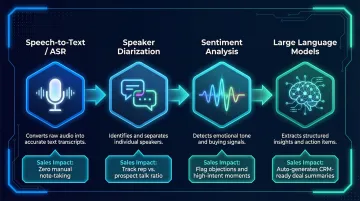
The transcription and NLP layer converts speech to text, including accents and domain-specific terminology, then applies named entity recognition, intent detection, keyword extraction, and sentiment classification. The result is raw dialogue transformed into searchable, filterable data that reveals patterns no individual listener could catch at scale.
Surfacing Revenue-Relevant Signals
Not all conversation data carries equal weight. The signals that move pipeline include:
- Objection frequency and type across calls
- Competitor mentions and how reps respond to them
- Pricing sensitivity indicators
- Buyer sentiment trajectory (how tone shifts throughout a call, not just the overall rating)
- Engagement drop-offs and attention gaps
- Whether key stakeholders were identified or missed entirely
AI scoring and metadata tagging evaluate each call against rep behaviors, questioning quality, talk ratio, objection handling, and produce comparable, auditable data across the entire team. That consistency is what makes performance review scalable beyond manager spot checks.
Analyzed call data syncs back into CRM records, pipeline views, and enablement workflows automatically, so insights reach the systems where sales leaders already make decisions, without adding a manual step for reps.
Key Benefits of Conversational Analytics for Sales Teams
Evidence-Based Coaching
Instead of feedback based on manager opinion or random call samples, every rep is scored on consistent criteria across every call. Managers review patterns rather than individual calls, identifying the specific behaviors, questioning depth, objection handling, talk ratio, that differentiate top performers from average ones.
Dynamic, formal coaching drives a 55.2% win rate (19% above average) and a 21.3% improvement in quota attainment. Yet a massive disconnect exists: while 90% of leaders claim they coach their team at least once a month, 38% of reps say they rarely or never receive coaching, and 14% get none at all. Conversational analytics closes this gap by making coaching consistent, data-driven, and replicable.
Objection Intelligence at Scale
When dozens or hundreds of calls are analyzed, recurring objections surface as patterns rather than isolated incidents. Sales leaders can see which objections appear most in late-stage deals, which competitor names come up most often, and what messaging is failing before those issues derail close rates across the team.
Analysis of 67,149 sales calls found that successful salespeople pause immediately after a customer's objection for 5x longer than less-successful peers. Top performers ask questions 54.3% of the time during objections, diagnosing buyer concerns rather than pitching harder. Without systematic call analysis, these behavior gaps stay invisible, and unfixed.
Pipeline Risk Detection Before Deals Are Lost
Sentiment trajectory analysis and engagement signals flag deals that are drifting, reduced buyer engagement, increased hesitation language, rising competitor mentions. Sales managers can intervene while there's still time to rescue or requalify.
Traditional forecasting relies on subjective rep inputs, which is why nearly 60% of forecasted deals slip to the next quarter. Deals with verified buying signals close at 2-3x the rate of deals without them, making conversation-based risk detection far more reliable than CRM field updates alone.
Onboarding and Ramp Acceleration
New reps can access a library of high-performing calls filtered by deal type, objection category, or product line. Instead of shadowing one experienced rep for weeks, they have structured, searchable examples of winning behavior patterns.
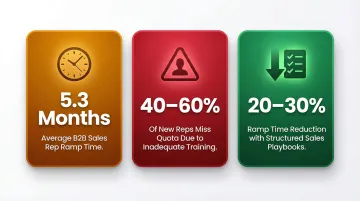
The numbers show how large the opportunity is:
- Average B2B sales ramp time: 5.3 months
- 40–60% of new reps miss quota due to inadequate training
- Structured sales playbooks during onboarding cut ramp time by 20–30%
ComplyAdvantage used call libraries of winning conversations to reduce new rep ramp time by 50%.
Forecast Accuracy Improvement
Revenue leaders can validate pipeline health using conversation signals rather than relying solely on rep self-reporting. A deal marked "closing next quarter" that shows declining engagement in recent calls is a different risk profile than one with strong buyer-side language.
The practical result: managers stop treating every "high confidence" deal equally. When conversation data shows a stalled stakeholder, missing economic buyer, or repeated competitor mentions, those signals adjust the forecast before the quarter-end surprise.
Turning Insights Into Coaching: The Prescriptive Learning Loop
Most conversational analytics tools leave a critical gap: insights surface, scorecards are produced, but actual behavior change requires that gap identification translate automatically into a training action. Teams that handle this manually, if they handle it at all, watch insight accumulate without consistent performance improvement.
The Prescriptive Learning Loop
AI scores a call and detects a specific gap: the rep isn't asking qualifying questions, struggles with a pricing objection, or over-talks in discovery. The system automatically routes that rep into targeted microlearning, a roleplay simulation, or a coaching session focused on that gap, not a generic training course.
Partner and channel sales ecosystems see outsized benefits from this loop. With resellers, distributors, and alliance partners, managers have limited direct visibility into sales conversations happening in the field. Conversational analytics that automatically triggers training when partners struggle extends the performance floor across the entire ecosystem, without requiring dedicated field coaching headcount for every partner.
Putting the Loop Into Practice
Pifini's platform makes this loop work in practice: every call is scored by AI, gaps are flagged, and users are automatically enrolled in targeted training through the built-in enterprise LMS. The result is continuous, data-driven improvement, not quarterly training cycles disconnected from what's actually happening in calls.
Sales reps typically forget most training content within a week. When conversational analytics triggers microlearning based on specific call gaps, the training arrives at exactly the moment it's needed. The impact is measurable:
- Microlearning boosts engagement by more than 50% compared to traditional formats
- Retention of training material improves by 23% when microlearning replaces conventional methods
- Training tied to a specific, recent call gap lands, rather than sliding off
Implementing Conversational Analytics in Your Sales Ecosystem
Choosing the Right Platform
Look beyond transcription accuracy to how the platform handles sales-specific signal types:
- Deal risk flags and objection categorization
- Competitive intelligence tracking
- Bidirectional CRM integration so insights reach pipeline reviews
- Scalability across distributed teams or partner channels
- Connection to enablement workflows rather than manual coaching handoffs
Platforms vary widely in depth. Some offer basic transcription with keyword search; others provide sentiment analysis, automated scoring, and prescriptive learning integration. Evaluate based on the signals that matter most to your sales motion, the checklist below maps common options to common needs.
Addressing Integration and Adoption Challenges
Well-built platforms still fail if reps perceive them as surveillance rather than support. Studies show that 50%-70% of CRM projects fail, often due to poor adoption and change management issues.
Implementation requires:
- Clear communication about how insights are used (coaching, not punishment)
- Workflow integration so analysis is automatic rather than an additional administrative task
- Leadership modeling of how data shapes decisions
Employee monitoring tools focused on tracking performance and deterring rule-breaking make employees more likely to break rules. Position conversational analytics as enablement, not enforcement.
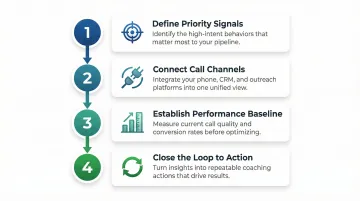
Implementation Checklist for Sales Leaders
- Define your priority signals based on sales motion: competitive mentions for crowded markets, objection patterns for complex products, or engagement drop-offs for long-cycle deals.
- Connect your call channels, integrate Zoom, Microsoft Teams, or your existing call recording system with the analytics platform.
- Establish a performance baseline before optimizing, measure talk ratios, objection handling rates, and sentiment patterns so you have something to improve against.
- Close the loop from insight to action, automatic training enrollment based on call scores outperforms manual coaching follow-up at every scale.
Frequently Asked Questions
What are conversational analytics platforms?
Conversational analytics platforms are AI-powered tools that automatically capture, transcribe, and analyze sales conversations across calls, video meetings, and chat. They convert unstructured dialogue into searchable data, surfacing signals like sentiment, objection patterns, and deal risk that sales leaders can act on.
What features should I look for in a conversational analytics platform?
Look for AI transcription, sentiment analysis, keyword and competitor tracking, call scoring, and deep CRM integration. The real value is replacing intuition-based management with evidence, consistent coaching, pipeline risk visibility, and forecasting grounded in actual conversation data.
How do I evaluate data analytics platforms for my sales team?
Focus your evaluation on four areas:
- Signal accuracy, sales-specific detection, not just transcription quality
- CRM integration depth, insights must reach pipeline workflows, not sit in a separate dashboard
- Scalability, coverage across distributed or partner teams, not just direct reps
- Insight-to-action loop, platforms that connect findings to training deliver real behavior change; those that stop at reporting don't
What is the difference between conversational analytics and call recording?
Call recording stores conversations while conversational analytics actively analyzes them, identifying patterns, scoring behaviors, flagging risks, and surfacing insights across hundreds of calls simultaneously in ways no human reviewer could replicate manually. Recording captures data; analytics transforms it into action.
How does conversational analytics improve sales coaching?
Conversational analytics replaces random spot-check coaching with consistent, data-driven feedback. Every call is scored on the same criteria, skill gaps are identified across all reps, and targeted training replaces generic programs, cutting ramp time and reducing reliance on manager bandwidth.