Introduction
Most sales leaders choose tracking software by comparing dashboards, pipeline reports, and CRM integrations, but miss the foundational question: Are you tracking what your reps know and can do, or just what they actually do?
According to Salesforce's State of Sales report, sellers use an average of 8 tools to close deals and 42% feel overwhelmed by that complexity. Overwhelmed reps are 45% less likely to attain quota. The root cause is rarely the tools themselves, it's that most organizations confuse two distinct problems: readiness (whether reps have the skills, knowledge, and coaching to win) and performance (whether they're executing against quota, pipeline, and forecast).
Track one without the other and you end up with dashboards full of red numbers and no explanation for why, or training programs you can't connect to revenue.
This article clarifies the distinction between readiness-focused tools and performance management platforms, and explains why your best-fit software depends entirely on where your biggest revenue leak actually lives.
Key Takeaways
- Readiness software prepares reps before buyer engagement through training, coaching, and certifications
- Performance software tracks outcomes as deals progress, pipeline health, quota attainment, forecasting, and deal-level execution
- Most underperforming teams have one without the other, skill gaps with no visibility, or data with no training system to act on it
- Unified platforms like Pifini.ai connect both sides by auto-enrolling reps into targeted training when AI detects performance gaps from call analysis
- Start by diagnosing the gap: if reps lack skills, you have a readiness problem; if skills exist but results don't, you have a performance problem
Sales Readiness vs. Sales Performance: What's the Real Difference?
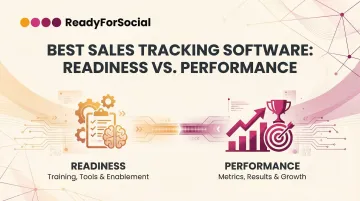
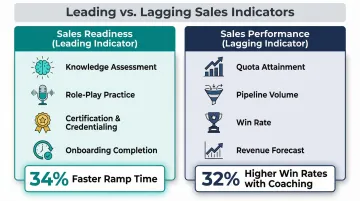
Sales readiness measures a rep's capability before and during customer engagement. It covers product knowledge, objection handling, messaging fluency, onboarding speed, and certification completion. Readiness is a leading indicator, it predicts future performance by assessing whether reps are equipped to execute. According to Richardson's research, readiness means a seller can follow the process, use selling collateral, and apply learned skills in the field.
Sales performance management tracks outcomes already in motion: quota attainment, pipeline velocity, win rates, forecast accuracy, and revenue against targets. Performance data is a lagging indicator, it tells you what happened, not why. Tools like Salesforce Sales Cloud, Gong, and Clari excel here, surfacing deal risk signals, conversation patterns, and pipeline health in real time.
The Critical Gap
Organizations that only track performance metrics, CRM dashboards, quota attainment, have no visibility into why reps underperform, only that they do. When 46% of companies don't offer training beyond onboarding, managers coach blind, guessing at root causes without data on skill gaps or knowledge deficiencies.
The proof problem runs the other direction too. Sales Assembly reports that 76% of sales leaders focused on enablement cannot prove how those efforts impact revenue, because they lack the infrastructure to connect learning outcomes to deal data. Teams invest in training platforms but can't link results to pipeline. Without that connection, you can't identify which skills move revenue or justify the enablement budget.
Two Questions, One System
- Readiness tools ask: "Is this rep ready to win?"
- Performance tools ask: "Is this rep winning?"
Both questions must be answered together to build a high-performing team. Structured onboarding reduces ramp time by up to 34%. Dedicated sales coaches produce 32% higher win rates. Those gains only show up in your numbers when readiness data is tied directly to performance outcomes, which is exactly what most teams are missing.
Best Sales Readiness Software: Tools That Prepare Your Reps to Win
Tools in this category were evaluated on how well they equip reps before and during buyer interactions, specifically through structured learning, AI coaching, role-play, content access, and readiness scoring tied to actual skill gaps.
Mindtickle
Mindtickle is a readiness platform built around structured microlearning, AI-driven role-play, and sales capability heatmaps. It's particularly strong in enterprise environments where managing readiness at scale across large, distributed teams is critical. The platform holds a 4.7/5 G2 rating based on 2,224 reviews and has analyzed activity from over 1 million users at more than 400 companies.
The standout differentiator is Mindtickle's Performance Correlation Engine, a feature that connects readiness activity (quiz scores, role-play completion, certification progress) to quota attainment data. Enablement leaders can use it to prove training ROI by showing which learning modules correlate with higher win rates and faster deal velocity.
Key capabilities at a glance:
- Microlearning paths mapped to specific skill gaps
- AI role-play scoring with manager-review workflows
- Readiness heatmaps across teams, regions, and roles
- Direct correlation between learning activity and quota attainment
Highspot / Seismic
Highspot and Seismic represent the content readiness category, platforms that ensure reps have the right content, battle cards, and guided selling materials at each stage of the deal. Both hold 4.7/5 G2 ratings, with Highspot named a Leader in the 2025 Gartner Magic Quadrant for Revenue Enablement. Readiness here is buyer-facing: reps show up to every interaction prepared with the right message, not just the right knowledge.
The trade-off is real: both platforms excel at content delivery and pitch preparation, but offer limited visibility into foundational skill gaps or rep-level learning progression. They work best alongside a dedicated training layer, not in place of one. Forrester notes that the impending merger of Highspot and Seismic signals market consolidation toward unified content and readiness clouds.
Pifini.ai
Where the tools above specialize in either structured learning or content delivery, Pifini.ai combines both in a single platform, and extends that coverage to partner ecosystems. The platform pairs an enterprise LMS (prescriptive learning paths, certifications, microlearning, gamification) with AI-powered call scoring and live coaching, priced at $50/user/year versus $300–$600 with legacy competitors.
The defining differentiator for channel-heavy organizations: Pifini.ai is built specifically for resellers, distributors, and alliances, not just direct sales teams. When AI detects performance gaps from call analysis, the platform auto-enrolls users into targeted training, connecting readiness directly to execution outcomes.
Its Training Impact Analysis Dashboard links learning activity to actual revenue results, identifying which courses drive the highest ROI and projecting ecosystem-wide impact. Documented outcomes from Pifini customers include:
- 40% faster training completion
- 30% higher program engagement
- 25% more deals registered per quarter
- Up to 94% training ROI in documented customer data
Best Sales Performance Management Software: Tools That Track and Drive Revenue Outcomes
Tools in this section were evaluated on pipeline visibility, quota and forecast accuracy, deal-level intelligence, CRM data depth, and how well they surface actionable coaching signals from performance data, not just report on it.
Salesforce Sales Cloud
Salesforce Sales Cloud is the enterprise standard for performance management, offering deep pipeline visibility, customizable dashboards, multi-dimensional forecasting, territory management, and tight automation of sales workflows. IDC reports that Salesforce led all CRM vendors in 2024 with a 20.7% market share, making it the backbone of performance tracking for mid-market and enterprise teams.
The limitation: Salesforce tracks what reps do, not whether they're equipped to do it well. Sales Programs and Enablement are paid add-ons, not standard features. Without an integrated training layer, performance dips show up in dashboards with no prescriptive path forward, just red numbers and no root cause analysis.
Gong / Clari
Gong captures calls, emails, and meetings to surface deal risk signals, coaching opportunities, and conversation patterns linked to wins. Key reported outcomes across both platforms:
| Platform | Metric | Result |
|---|---|---|
| Gong | 3-year ROI (Forrester TEI) | 481% + $10M NPV |
| Gong | Close rate lift on reviewed calls (Diligent) | +7.4% |
| Gong | New rep ramp time reduction | 3 weeks |
| Clari | Forecast accuracy (Fortinet) | 97% |
| Clari | 3-year ROI (Forrester TEI) | 398% |
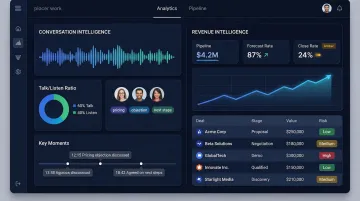
Both tools bring performance visibility down to the conversation level, which is precisely where readiness gaps become measurable. Gong's research finds that organizations using AI to drive their sales motion are 65% more likely to increase win rates.
HubSpot Sales Hub
For teams earlier in their growth curve, HubSpot Sales Hub delivers CRM, pipeline management, email engagement tracking, and reporting in one fast-to-adopt platform. It holds a 4.4/5 G2 rating from 13,620 reviews, with 64.5% of those reviewers coming from companies with 50 or fewer employees, reflecting its strong SMB footprint.
That SMB fit also reveals its ceiling. Where HubSpot falls short for complex organizations:
- Native reporting caps at 5 data sources per custom report, limiting cross-object analytics at scale
- No channel-specific functionality for reseller or distributor networks
- Lacks LMS depth or partner portal capabilities for extended enterprise use
How to Choose the Right Sales Tracking Software for Your Team
Simple decision framework:
- If your reps know what to do but aren't doing it consistently → performance management tools (CRM, pipeline tracking, forecasting) should be the priority
- If your reps don't know how to do it well → readiness tools (LMS, coaching, AI roleplay) are the missing layer
- If underperformance is happening and you can't tell why → you need both
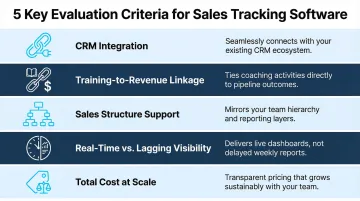
Five Key Evaluation Criteria
- CRM integration, Does it connect with your existing Salesforce, HubSpot, or Microsoft Dynamics instance?
- Training-to-revenue linkage, Can you correlate learning outcomes to actual deal data and win rates?
- Sales structure support, Does it work for direct, partner, or channel sales structures (or all three)?
- Real-time vs. lagging visibility, Does it surface actionable insights in the moment, or only historical reports?
- Total cost at scale, What's the all-in price including hidden add-ons, integrations, and implementation fees?
The Hidden Cost of Disconnected Tools
Running separate readiness and performance tools creates data silos that block coaching decisions. Managers can't connect a rep's training completion to their deal outcomes, making it nearly impossible to prove enablement ROI.
Running separate readiness and performance tools creates data silos that block coaching decisions. Managers can't connect a rep's training completion to their deal outcomes, making it nearly impossible to prove enablement ROI.
The consequences show up fast:
- No way to identify why a rep is underperforming, skill gap or execution gap
- Training spend that can't be tied to pipeline or win rate changes
- Reactive coaching based on gut feel rather than call or deal data
84% of sales teams without an all-in-one platform are planning to consolidate. Unified systems that auto-trigger targeted training from live performance gaps don't just reduce friction, they make coaching decisions defensible with data.
Frequently Asked Questions
What is the best sales tracking software?
The best tool depends on whether your primary need is readiness (training, coaching, certifications) or performance management (pipeline, forecasting, quota tracking). Unified platforms like Pifini.ai combine both in one system, connecting learning directly to revenue outcomes at $50/user/year, compared to $300–$600 with legacy platforms like Seismic or Mindtickle.
What is the difference between sales readiness and sales performance management software?
Readiness software prepares reps before and during customer engagement through training, role-play, and content delivery. Performance management software tracks outcomes already in motion: quota attainment, pipeline health, and win rates. Both are needed for complete visibility, readiness predicts future success, performance measures current execution.
Do small sales teams need both readiness and performance tracking tools?
Even small teams benefit from both, but the priority depends on stage. Early-stage teams often need readiness infrastructure first to build consistency and reduce ramp time. Scaling teams need performance tracking to identify where execution breaks down and which skill gaps correlate with missed quotas.
What features should I prioritize when choosing sales tracking software?
Focus on CRM integration, real-time performance dashboards, training-to-revenue linkage, ease of adoption, and scalability. Platforms that automatically deploy targeted training when performance gaps appear deliver the strongest ROI, cutting time-to-competency while linking learning directly to deal outcomes.
Can AI-powered platforms replace separate readiness and performance tools?
AI-powered unified platforms can consolidate both functions, using call scoring and gap detection to automatically route reps into relevant training based on detected skill gaps. However, verify the depth of both the LMS and the performance analytics before consolidating. Platforms purpose-built for extended enterprise (partners, resellers, distributors) often deliver better results than retrofitted direct-sales tools.
How does linking training to performance data improve win rates?
When training is triggered by actual performance gaps rather than scheduled generically, reps receive targeted coaching at the exact moment it's needed. Research shows firms that provide optimal coaching realize 16.7% greater annual revenue growth than firms without, making gap-triggered, deal-level coaching one of the highest-ROI investments a sales org can make.