Only 16% of organizations can effectively track learning metrics to business impact, creating a trust gap between training vendors and revenue leaders. Your pitch must close that gap immediately.
This guide gives you a proven framework and ready-to-use templates. You'll walk away with a 6-part pitch structure, 4 adaptable templates (elevator pitch, cold email, discovery call, partner pitch), and practical guidance on tailoring your message to sales leaders, L&D teams, and channel partners.
Key Takeaways
- Lead with outcomes, not features, buyers care about pipeline impact, not training modules
- Use the 6-part framework, hook, value statement, differentiators, proof, ROI bridge, CTA
- Tailor by buyer type, sales leaders want quota lift, L&D wants adoption data, partners want revenue impact
- AI roleplay practice matters, reps who rehearse objection handling before live calls consistently outperform those who don't
What Makes Pitching an AI Training Platform Unique
Pitching an AI training platform isn't like selling standard SaaS tools. Buyers aren't evaluating software alone, they're evaluating whether their team will actually use it and whether it will move revenue metrics. The purchase decision hinges on behavior change, not technical capabilities.
The objections you'll hear most often:
- "We already have an LMS"
- "Our team won't adopt another tool"
- "We tried training programs before and saw no ROI"
These aren't objections to your platform, they're objections to the category. Your pitch needs to acknowledge this reality upfront and address it head-on.
The Invisible ROI Problem
Training outcomes, certifications, completion rates, rarely connect to revenue metrics like win rates, deal size, or ramp time. Brandon Hall Group found that fewer than 16% of organizations can identify and track learning metrics through to business impact. Buyers can't prove training delivers results, so they delay decisions or default to "no decision" entirely.
Why Partner Pitches Are a Different Challenge
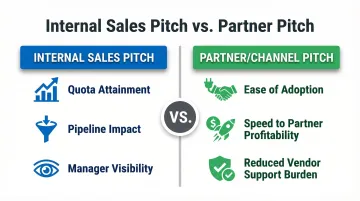
When pitching to resellers, distributors, or alliance partners, you're speaking to a different set of motivations. Internal sales teams care about hitting quota. Partners care about margin, ramp time, and support burden. A pitch that lands with a VP of Sales will fall flat with a channel manager evaluating partner profitability.
What Your Pitch Must Do Differently
To cut through category skepticism, your AI training pitch needs to be:
- Outcome-led, lead with business results, not feature lists
- ROI-anchored, draw a direct line from learning to revenue metrics
- Adoption-confident, address the "will they actually use it" question before it's asked
- Audience-specific, different buyers need different angles, especially when partners are involved
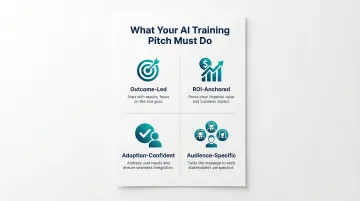
The templates and frameworks below are built on each of these requirements.
The 6-Part Framework for a Winning AI Training Platform Pitch
Part 1, The Hook (Problem Statement)
Open with the specific pain the buyer is experiencing, not a vague industry challenge, but a precise, recognized problem. Use this formula:
"Right now, [role] at [company type] are losing [X outcome] because [specific training gap]."
Example: "Right now, channel partners at enterprise SaaS companies are losing 30–40% of deals in the first six months because new resellers ramp too slowly and can't handle objections confidently."
Leading with pain makes the buyer lean in. They recognize the problem immediately and want to hear the fix.
Part 2, The Value Statement
Your value statement is a single, jargon-free sentence that tells the buyer exactly what changes when they adopt the platform.
Weak value statement: "We offer AI-powered microlearning and gamification."
Strong value statement: "We help channel partners ramp in half the time and close 30% more deals by connecting AI coaching directly to their sales calls."
The difference is outcomes vs. features. Buyers don't care what the platform does, they care what changes in their numbers.
Part 3, How It Works (Differentiators)
Explain 2–3 platform differentiators that directly address the buyer's stated pain. Express differentiators as outcomes, not features.
Feature language: "Built-in call scoring and AI roleplay."
Outcome language: "AI scores every call and auto-enrolls struggling reps into targeted training, so managers don't have to manually identify skill gaps or assign courses."
The example above shows both the mechanism and the relief it creates. That combination is what moves buyers forward.
Part 4, Proof (Social Proof & Data)
AI platforms face high skepticism. Social proof builds credibility fast. Reference customer names, deal wins, or ROI data. Even referencing customer types, without naming names, still builds credibility.
Examples:
- "Enterprise brands like AMD and Hexagon use our platform to train global reseller networks."
- "Companies using our platform see a 46% training success rate with 17% average performance improvement."
If you can't share customer names, reference customer types: "Fortune 500 manufacturers," "global SaaS reseller networks," "enterprise technology distributors."
Part 5, The ROI Bridge
This is the element most pitches skip, connecting the platform directly to measurable business outcomes. Use this template:
"Companies using [platform] see [specific outcome] within [timeframe], because [mechanism]."
Example: "Companies using Pifini see partners closing 25% more deals per quarter within 90 days, because AI call scoring identifies objection-handling gaps and automatically routes users into targeted training."
For every dollar invested in training, companies receive about $4.53 in return, a 353% ROI. Buyers won't trust that stat on its own. Connect your platform's specific capabilities to their specific revenue metrics, and the number becomes believable.
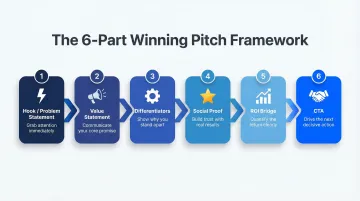
Part 6, The CTA (Call to Action)
Match your CTA to the buyer's stage in the decision process.
Cold pitch: "Can I send you a 2-minute demo video?"
Warm prospect: "Would a 30-minute pilot session with your top three reps make sense this week?"
Advanced conversation: "Let's schedule a live trial with your channel team, we'll show ROI impact in 30 days."
Strong pitches fail most often at this single step. Always close with a specific next action, never leave the buyer to decide what happens next.
4 Ready-to-Use Sales Pitch Templates for an AI Training Platform
These templates follow the 6-part framework but are calibrated to specific formats and buyer contexts. Adapt the placeholders to your buyer's role, industry, and the specific metric they care most about, don't use them verbatim.
Elevator Pitch Template (60–90 Seconds)
Structure: One-sentence problem hook → one-sentence value statement → one differentiator → one proof point → one CTA question.
Worked Example:
"Most VPs of Sales we talk to are losing 30–40% of deals in the first six months because new reps and partners ramp too slowly. Our platform cuts ramp time in half and increases win rates by connecting AI coaching directly to live sales calls. Unlike legacy tools, we auto-enroll struggling reps into targeted training based on real call performance, no manual intervention. Companies like AMD and Hexagon use us to train global reseller networks and report 25% more deals registered per quarter. Would it be worth a quick look?"
Fill-in-the-Blank Template:
"Most [role]s we talk to are losing [outcome] because [training gap]. Our platform [value statement], using [differentiator]. Companies like [customer type] have seen [result]. Would it be worth [low-friction next step]?"
Cold Email Pitch Template
Subject Line Formats That Perform:
- "Quick question about [Company]'s partner ramp time"
- "How [Similar Company] cut sales onboarding by 50%"
- "[First Name], fixing the training-to-revenue gap"
Email Body:
Subject: Quick question about [Company]'s partner ramp time
Hi [First Name],
I noticed [Company] recently [specific business context: launched new partner program / expanded into new region / announced growth initiative]. Congrats on the momentum.
Most [role]s in your position tell us their biggest challenge right now is ramping new partners fast enough to hit revenue targets, especially when those partners are juggling multiple vendor relationships.
We built [Platform Name] to solve exactly that. It's an AI-powered enablement platform that connects training directly to sales performance, so partners ramp in weeks instead of months. Our customers, enterprise brands like AMD, Hexagon, and Bobcat, report 40% faster training completion and 25% more deals registered per quarter.
Worth a 15-minute conversation? I can show you how [similar company type] used our platform to cut partner ramp time in half.
Best,
[Your Name]
[Link to 2-minute demo video]
Discovery Call Opening Pitch Template
First 2 Minutes:
Rapport + Context (30 seconds):
"Thanks for taking the time today, [Name]. I know you're evaluating a few platforms right now, so I want to make sure we use this time well. My goal is to understand where you're seeing the biggest gaps in your current enablement approach, and if there's a fit, show you exactly how we've helped companies like [similar company] solve those problems."
Provocative Question (transition to diagnosis):
"Before I jump into the platform, let me ask, when you look at your sales team or partner ecosystem today, what's the one metric you wish you could move faster? Is it ramp time, win rates, deal size, or something else?"
[Listen. Let them articulate the pain.]
Transition to Pitch:
"That's exactly what we built this for. Let me show you how [Platform] connects training directly to [the metric they just mentioned], and why companies like [customer example] saw [specific result] in [timeframe]."
This format works especially well with sales leaders and revenue ops teams, because it anchors the entire demo around a metric they already care about, rather than a feature tour they didn't ask for.
Partner/Channel Pitch Template
Structure for Resellers, Distributors, Alliance Partners:
Pitch Script:
"Most channel managers we work with tell us their biggest frustration is that partners ramp too slowly, struggle with objections, and generate too many support escalations, all of which hurt both partner profitability and vendor revenue.
Our platform solves this by giving your partners the same AI-powered coaching and enablement your direct sales team uses, without adding complexity or cost burden to your partner program. Here's what changes:
- New resellers get productive in weeks, not months, AI roleplay lets them practice discovery calls and objection handling before they face real buyers.
- Partners report 25% more deals registered per quarter because they're confident, trained, and equipped with the right content at the right time.
- Auto-enrollment into targeted training when performance gaps are detected means fewer support tickets and fewer lost deals.
Your partners generate more revenue, faster, with less hand-holding from your team. Companies like [customer example] scaled their partner ecosystem 40% year-over-year as a direct result.
Can we set up a pilot with 3–5 of your top partners and show you the impact in 30 days?"
Key Difference from Internal Sales Pitch:
Partner pitches emphasize ease of adoption, speed to partner profitability, and reduced vendor support burden. Internal pitches emphasize quota attainment, pipeline impact, and manager visibility.
How to Tailor Your AI Training Platform Pitch to Different Buyers
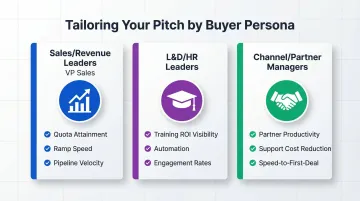
Three Primary Buyer Personas
1. Sales/Revenue Leaders (VP Sales, CRO, Sales Managers)
These buyers measure everything against quota. Lead with speed and revenue impact:
- "Our platform helps you hit quota faster by cutting ramp time in half."
- "Companies using our AI call coaching see a 17% improvement in win rates because reps get real-time feedback during actual customer calls."
- "We connect training directly to pipeline metrics, certifications to closed deals, call scores to win rates."
2. L&D/HR Leaders (Learning & Development Directors, HR Business Partners)
These buyers need to prove learning ROI upward, to CFOs and CROs who want numbers, not completion rates. Focus on visibility and automation:
- "Our platform delivers 40% faster training completion and 30% higher engagement because it's built around microlearning, gamification, and mobile accessibility."
- "You'll finally be able to show your CFO and CRO exactly how training impacts revenue, our Training Impact Analysis connects certifications to deal performance."
- "We solve the adoption problem proactively: AI auto-enrolls users when performance gaps are detected, so you're not chasing people to complete courses."
3. Channel/Partner Managers (Channel Chiefs, Partner Program Directors)
These buyers are measured on partner-sourced revenue and support overhead. Lead with speed-to-first-deal and ticket reduction:
- "Partners using our platform register 25% more deals per quarter because they ramp faster and handle objections confidently."
- "You'll reduce partner support tickets by 30% because AI coaching and auto-enrollment fix skill gaps before they become escalations."
- "Our Partner Enablement Hub gives resellers instant access to training, certifications, and deal resources, replacing manual onboarding with self-serve training and instant AI support."
How to Research a Buyer's Current Training Pain
Knowing which persona you're targeting only works if you can identify them before the first call. These signals, visible on LinkedIn, in job postings, and in company news, tell you which pain to lead with:
- Scaling a partner ecosystem? Look for recent announcements about new reseller programs, distributor partnerships, or alliance expansions. This signals channel enablement needs.
- Rebuilding a sales team? Job postings for multiple SDR or AE roles indicate ramp time and onboarding efficiency are top priorities.
- Managing high rep turnover? If the same sales roles are posted repeatedly, training ROI and retention are pain points.
- Recent funding or growth announcements? Fast-growing companies need scalable enablement that doesn't require proportional increases in L&D headcount.
Adjust Pitch Length and Formality by Context
| Format | Ideal Length | Buyer Stage |
|---|---|---|
| LinkedIn DM | 2–3 sentences | Cold outreach |
| Cold email | 100–150 words | Initial awareness |
| Discovery call | 5–10 minutes | Active evaluation |
| Boardroom demo | 30–45 minutes | Final decision stage |
Mismatching pitch length to buyer stage is one of the most common reasons good pitches fail to advance. A VP Sales getting a 400-word cold email treats it like spam. A CFO getting a 3-sentence demo pitch assumes you're not serious.
Common Mistakes When Pitching an AI Training Platform
Mistake 1, Leading with Features Instead of Outcomes
Pitching "AI-powered microlearning and gamification" without connecting those features to pipeline impact makes your platform sound like a nice-to-have rather than a revenue driver. When buyers focus on outcomes rather than features, 71% of purchases result in high-quality deals, compared to just 3% when they don't.
Reframe every feature as the business outcome it creates:
- Feature-led: "Our platform includes AI roleplay, call scoring, and an enterprise LMS."
- Outcome-led: "Our platform cuts partner ramp time in half and increases deal registration by 25% by connecting AI coaching to live sales calls and auto-enrolling struggling reps into targeted training."
Don't say "built-in call scoring", say "AI scores every call and flags skill gaps automatically, so managers know exactly where to coach."
Mistake 2, Ignoring the Adoption Objection
Most buyers have been burned by LMS platforms with low engagement and high abandonment. 88% of business transformations fail to achieve their original ambitions.
Meanwhile, 60% of digital adoption efforts fail due to insufficient investment in learning and development. A pitch that doesn't proactively address "will our team actually use this?" loses credibility before you get to the demo.
Address it before they ask, using a rebuttal like this:
"I know adoption is a concern, most L&D teams we talk to have tried platforms where completion rates tanked after month one. Here's what's different:
- Simple, modern UI: Built for sellers, not L&D admins. Mobile-first, no clunky interfaces.
- Gamification and microlearning: Short, focused modules (3–5 minutes) with leaderboards and rewards that drive engagement.
- Auto-enrollment triggered by performance gaps: If a rep struggles with objection handling on a call, the system automatically assigns the relevant training. They don't have to remember to log in, the platform meets them where they are."
Mistake 3, Pitching the Same Message to All Stakeholders
A pitch that resonates with an L&D director will fall flat with a VP of Sales. Each stakeholder has a different definition of success:
- L&D Directors: Certifications, completion rates, and training consistency
- VP of Sales: Quota attainment, ramp speed, and pipeline velocity
- Channel Managers: Partner productivity and support cost reduction
Tailor the emphasis of your pitch, not the entire structure, to match each buyer. Use the same 6-part framework, but adjust the hook, value statement, and ROI bridge to align with what each stakeholder actually measures. The "How to Tailor Your Pitch" section above covers persona-specific language in detail.
How to Practice and Refine Your AI Training Platform Pitch
In teams where reps are coached weekly or more, 76% hit quota, compared to just 47% when coaching drops to quarterly or less. How often your reps practice their pitch matters as much as the pitch itself.
Platforms like Pifini include built-in AI roleplay and live call coaching where reps practice against simulated buyer personas, get scored on delivery, and are automatically routed into corrective training when gaps surface. Pitch refinement becomes a feedback loop tied to real call outcomes, not a one-time workshop.
3 Practical Steps for Ongoing Pitch Refinement
1. Record and self-review each delivery
Listen for:
- Filler words ("um," "like," "you know")
- Rushed sections where you lose clarity
- Weak transitions between framework parts
- Moments where you sound uncertain
2. Run AI roleplay against tough objection scenarios
Practice against scenarios like:
- "We already have an LMS"
- "Your competitors are cheaper"
- "How do we know our team will actually use this?"
- "Can you prove ROI in the first 90 days?"
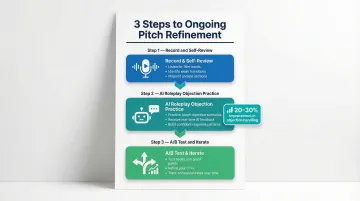
3. A/B test pitch variations and iterate
Test variations:
- Different hooks (pain-focused vs. outcome-focused)
- Different proof points (customer names vs. ROI stats)
- Different CTAs (demo video vs. live call)
Track discovery call and demo request rates for each version. The variation that consistently opens conversations is the one worth standardizing.
Frequently Asked Questions
What are some catchy sales pitch examples for an AI training platform?
Strong opening lines:
- "Most channel partners lose 30% of deals in the first six months because they ramp too slowly, our platform cuts that time in half."
- "We help sales leaders prove training ROI by connecting certifications directly to win rates and pipeline growth."
- "Your partners generate 50–70% of revenue, but most enablement tools ignore them, ours is built partner-first."
Focus on specific outcomes and precise pain points, not generic feature claims.
How can I use AI in sales for an AI training platform?
Two key applications: use AI tools to personalize pitch content at scale, tailoring outreach, discovery questions, and demo scripts by persona and industry. Then use AI roleplay platforms to practice delivery and handle objections, with real-time feedback on tone, clarity, and messaging.
What are the 3 C's of an elevator pitch for an AI training platform?
Clear, Ditch jargon. Say "auto-enrollment into targeted training," not "prescriptive learning pathways." If a VP of Sales can't parse it in 5 seconds, rewrite it.
Concise, Keep it under 90 seconds or 3 sentences. Cut anything that doesn't move the buyer closer to a yes.
Compelling, Tie your pitch to a specific business outcome the buyer cares about, such as faster partner ramp, higher win rates, or measurable training ROI.
What should I include in a sales pitch for an AI training platform?
Cover six elements: a problem hook, a value statement, 2–3 differentiators tied to their pain, social proof (customer names or ROI data), an ROI bridge connecting training to revenue outcomes, and an explicit call to action. Every element should connect directly to what the buyer is already trying to solve.
How do I pitch AI training ROI to skeptical decision-makers?
Ask what metric they're already tracking, quota attainment, time-to-first-deal, partner productivity, then show how training moves it. For example: "Companies using our platform see partners closing 25% more deals per quarter within 90 days because AI call scoring flags objection-handling gaps and auto-enrolls users into targeted training."
What is the difference between an elevator pitch and a full sales presentation for an AI training platform?
An elevator pitch is a 60–90 second hook covering problem, value, one differentiator, one proof point, and a CTA, its only job is to earn the next conversation. A full sales presentation covers detailed proof, ROI data, competitive differentiation, case studies, and a live demo. One opens the door; the other closes the deal.