Introduction
Most revenue and sales enablement platforms now claim to be "AI-powered." Few actually are. Gartner predicts over 40% of agentic AI projects will be canceled by the end of 2027, largely because vendors engage in "agent washing", rebranding basic automation as AI without genuine autonomous capability. For sales leaders and channel program managers, choosing the right platform now carries real strategic weight.
With dozens of vendors claiming AI-powered coaching, learning, and partner enablement, decision-makers struggle to separate genuine capability from marketing noise. Many platforms mention AI in their pitch but lack the depth of integration needed to deliver real results. Choosing the wrong one slows your team down and locks you into a system that can't scale.
This guide cuts through that. You'll get a curated list of top AI-assisted revenue enablement platforms for 2026, the criteria used to evaluate them, and a practical framework to match your program needs to platform capabilities.
Key Takeaways
- AI-assisted development uses machine learning, LLMs, and automated workflows to accelerate code generation, testing, and delivery across the full software development lifecycle
- The best partners embed AI into engineering culture, delivery pipelines, and quality processes, not just individual developer workflows
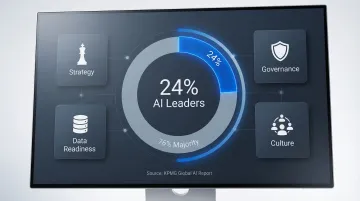
- Only 24% of organizations reach top AI maturity, measured across strategy, governance, data readiness, and culture
- Evaluation factors include AI workflow maturity, agentic capabilities, ISO/IEC 42001 compliance, and verified process depth
- Choosing the wrong partner risks slower delivery, technical debt accumulation, and security vulnerabilities
What Is AI-Assisted Software Development?
AI-assisted software development is the systematic use of AI tools, including generative AI, machine learning models, and LLM-based copilots, to support coding, testing, architecture review, documentation, and CI/CD throughout the SDLC. Using an AI tool occasionally is individual productivity. Genuine AI-assisted development at the organizational level means AI is embedded in code review processes, test generation workflows, security scanning, and deployment pipelines, not reached for when a developer hits a wall.
The 2025 DORA State of AI-assisted Software Development report reveals that AI acts as an amplifier, magnifying the strengths of high-performing teams but accelerating technical debt generation in low-maturity environments.
The profiles below cover the leading AI-assisted development partners for 2026: firms where AI operates as a structural delivery advantage built into how they work, not a capability bolted on afterward.
Top AI-Assisted Software Development Partners for 2026
These firms were evaluated on AI integration depth, engineering culture, LLM and generative AI capabilities, compliance posture, and demonstrated value to enterprise or growth-stage clients.
Thoughtworks
Founded in 1993 and headquartered in Chicago, Thoughtworks is a global technology consultancy with over 10,000 employees. The firm specializes in enterprise digital transformation, cloud-native architecture, and responsible AI implementation.
Thoughtworks integrates AI across its delivery model through a focus on responsible AI governance, architectural soundness, and long-term technical sustainability. Its approach emphasizes model explainability, bias detection, and AI ethics frameworks alongside technical implementation, making it well-suited for regulated industries.
| Category | Details |
|---|---|
| Key Capabilities | Custom AI model development, responsible AI governance frameworks, cloud-native modernization |
| Best Suited For | Enterprise organizations in finance, healthcare, and government requiring deep compliance alignment and ethical AI deployment |
| AI Tools / Stack | TensorFlow, PyTorch, OpenAI APIs, AWS SageMaker, Azure AI, custom LLM fine-tuning |
Toptal
Toptal is a global talent network founded in 2010, connecting companies with freelance software developers, designers, and project managers. The platform maintains a selective screening process, accepting only the top 3% of applicants.
Toptal runs on a distributed model of AI-augmented experts rather than a centralized development team. Developers leverage AI coding assistants individually, with the platform connecting clients to specialists experienced in GitHub Copilot, Cursor, and other LLM-based tools.
| Category | Details |
|---|---|
| Key Capabilities | Rapid team scaling, AI-augmented development for MVPs, specialized AI/ML engineers on-demand |
| Best Suited For | Startups and mid-market companies needing fast AI-skilled talent without long-term commitments |
| AI Tools / Stack | GitHub Copilot, OpenAI Codex, LangChain, Hugging Face, client-specified AI stacks |
Accenture
Accenture is a Fortune Global 500 company founded in 1989, headquartered in Dublin, with over 738,000 employees worldwide. The firm provides consulting, technology, and outsourcing services across all major industries.
Accenture's AI differentiation stems from its scale and enterprise infrastructure. Its dedicated AI labs and partnerships with major platform providers enable end-to-end transformation programs spanning strategy, implementation, and managed services.
AI governance is embedded across delivery through proprietary frameworks and ISO/IEC 42001-aligned processes, a key advantage for enterprises with strict compliance requirements.
| Category | Details |
|---|---|
| Key Capabilities | Enterprise AI transformation, AI-powered testing automation, large-scale cloud migration with AI integration |
| Best Suited For | Fortune 500 enterprises requiring comprehensive AI strategy, governance, implementation, and managed services |
| AI Tools / Stack | Proprietary AI frameworks, Microsoft Azure AI, AWS AI services, Google Vertex AI, custom LLM orchestration |
Infosys
Founded in 1981 and headquartered in Bangalore, India, Infosys is a global IT services and consulting firm with over 350,000 employees. The company provides business consulting, technology, engineering, and outsourcing services.
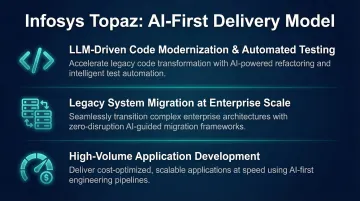
Infosys differentiates through its AI-first delivery model branded as "Infosys Topaz," combining generative AI services, AI platforms, and AI-augmented engineering. Key integration areas include:
- LLM-driven code modernization and automated testing
- Legacy system migration at enterprise scale
- High-volume application development with cost-optimized offshore delivery
| Category | Details |
|---|---|
| Key Capabilities | AI-powered application modernization, automated code migration, generative AI integration for enterprise apps |
| Best Suited For | Large enterprises managing legacy system transformations, high-volume development projects, and cost-sensitive offshore delivery |
| AI Tools / Stack | Infosys Topaz (proprietary), OpenAI GPT models, AWS Bedrock, Azure OpenAI Service, Google Gemini |
DataRobot Engineering Services
DataRobot, founded in 2012 and headquartered in Boston, is an enterprise AI platform provider. Its engineering services arm delivers custom AI and machine learning solutions built on its automated ML platform.
DataRobot's strength lies in operationalizing AI models within software applications. It specializes in MLOps, model governance, and embedding predictive AI into business applications, with engineering services focused on AI-native product development rather than general software. This makes it a strong fit for companies building data-intensive, AI-driven products.
| Category | Details |
|---|---|
| Key Capabilities | AI model operationalization, MLOps pipeline integration, predictive AI embedding in SaaS products |
| Best Suited For | SaaS companies and enterprises building AI-native applications requiring production ML infrastructure |
| AI Tools / Stack | DataRobot AutoML platform, TensorFlow, PyTorch, Kubernetes, MLflow, custom model deployment frameworks |
What Makes a Great AI-Assisted Development Partner in 2026
The shift toward agentic AI workflows separates true leaders from laggards. Agentic development means multi-step task automation: code generation, API research, documentation, and test case creation with minimal human hand-holding. Forrester notes that enterprises are driving demand for sophisticated "role-based" AI agents that orchestrate tasks across multiple systems. Partners without this capability slow teams down rather than accelerate delivery.
Top partners use AI not just to generate code faster, but to validate architectural consistency, detect vulnerabilities early, and enforce coding standards across distributed teams. The 2025 DORA report reveals that low-maturity AI implementations create a "verification tax," where time saved generating code is re-allocated to auditing and verification. Mature partners build AI-driven quality assurance into every workflow, reducing rework rather than increasing it.
Engineering culture is the differentiator. The best firms socialize AI tooling across teams, maintain shared knowledge channels, and run regular AI workflow improvement practices. This contrasts with firms where AI use is inconsistent or left to individual developers. KPMG data shows only 24% of organizations qualify as AI "Leaders" based on strategy, governance, data readiness, and culture.
Many vendors claim AI capabilities based on tool mentions, "we use Copilot", without verified process maturity. Two questions cut through the noise:
- Which AI tools are embedded in your CI/CD pipelines, and can you show configuration files?
- How do you enforce coding standards using AI, and can you share workflow documentation?
Partners who can't answer both with specifics and documentation aren't running AI at the process level, they're running it at the individual level, which won't scale.
How to Choose the Right AI-Assisted Development Partner
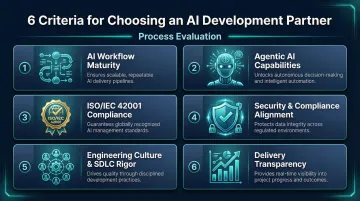
Evaluate partners using these six criteria, each tied to a business outcome:
1. AI Workflow Maturity
Does the partner embed AI into code review, test generation, and deployment pipelines? Mature partners use AI to automate repetitive tasks and enforce quality standards, reducing cycle time and defect rates.
2. Agentic AI Capabilities
Can the partner demonstrate multi-step autonomous workflows where AI handles research, generation, and validation with minimal supervision? This capability directly impacts delivery speed.
3. ISO/IEC 42001 Compliance
ISO/IEC 42001:2023 is the global standard for AI management systems, providing frameworks for risk, transparency, and traceability. Partners certified to this standard demonstrate responsible AI governance.
4. Security & Compliance Alignment
Does the partner address Shadow AI risks, license contamination, and code provenance tracking? The 2026 Open Source Security Report highlights that unmonitored AI usage creates compliance failures invisible to standard dependency scanners.
5. Engineering Culture & SDLC Rigor
How does the firm socialize AI tools, run retrospectives, and improve workflows? High-maturity teams treat AI as a team capability, not individual productivity.
6. Delivery Transparency
Can the partner provide metrics on AI-assisted delivery outcomes, cycle time reduction, defect rates, rework costs? Lack of data indicates immature tracking.
Match Partner Type to Project Context
Large global consultancies like Accenture suit enterprise modernization or regulated-industry deployments requiring comprehensive governance. Specialist mid-size firms or talent networks like Toptal offer faster cycles and deeper AI integration for product builds or MVPs.
Use this decision lens:
- Enterprise scale + compliance-heavy: Choose global consultancies with ISO/IEC 42001 certification
- Mid-market + speed-focused: Choose specialist firms with proven agentic workflows
- Startup + MVP: Choose talent networks with AI-skilled engineers
The most common mistake is choosing on brand name or hourly rate alone, without probing AI process depth. Partners with shallow AI adoption typically deliver slower cycles, higher defect rates, and rework costs that erode any initial savings.
For organizations managing multiple development vendors simultaneously, tracking partner performance against consistent metrics is just as important as the selection criteria above. Pifini.ai addresses this for revenue and partner teams, enabling certification, performance measurement, and accountability across technology partner ecosystems.
Conclusion
AI-assisted software development is the operational standard for 2026. The best development partners embed AI throughout the entire engineering lifecycle, not just at the code editor level. Evaluate partners on process maturity, agentic capability, ISO/IEC 42001 compliance, and cultural AI fluency, not on brand name or hourly rate alone.
The right partner accelerates delivery and scales with your product. The wrong one amplifies existing weaknesses, generating technical debt faster than any traditional development shop would. Use this guide's evaluation criteria to pressure-test every shortlist candidate before signing.
Frequently Asked Questions
What is AI-assisted software development?
AI-assisted software development refers to the practical use of AI tools, including LLMs, generative AI, and ML models, to support coding, testing, documentation, and architecture across the development lifecycle. Human engineers maintain oversight and strategic direction while AI handles repetitive tasks and quality checks.
How do AI-powered development partners deliver software faster?
AI accelerates delivery through automated code generation, AI-assisted test creation, faster prototyping, and LLM-driven code review. This reduces time spent on repetitive tasks, allowing engineers to focus on architecture, business logic, and complex problem-solving. Mature partners report 40% faster completion rates.
Is AI-generated code safe to deploy in production?
AI-generated code can be production-ready when governed by experienced engineers and proper security review. The real risk is unreviewed code, not AI generation itself. Mature partners treat AI output as a first draft, building validation and security scanning into every workflow before deployment.
What industries benefit most from AI-assisted development?
Finance, healthcare, logistics, and enterprise SaaS benefit most due to high complexity, need for rapid iteration, and data-heavy environments. AI-assisted development is also increasingly common in startups requiring fast MVP cycles and companies managing legacy modernization projects.
How do I evaluate whether a development partner truly uses AI or is just marketing it?
Ask for specifics: which AI tools are embedded in CI/CD pipelines, how teams enforce coding standards using AI configuration files, whether LLMs are used for code review and test generation, and whether the company can share workflow documentation or case examples. Partners with genuine AI maturity will give concrete tool names and show process documentation, not just talk about AI in general terms.
How much does AI-assisted software development typically cost?
Rates vary by partner size, geography, and AI integration depth: global consultancies charge $150–$300/hr, mid-size specialists charge $100–$200/hr, and offshore firms charge $50–$100/hr. Higher AI maturity often reduces total project cost through fewer rework cycles, offsetting higher hourly rates.