Introduction
Every sales call, support interaction, and customer touchpoint carries emotional signals that most businesses still miss entirely. Organizations rely on manual reviews or post-call surveys that capture only a fraction of the story, and by the time a negative sentiment is recorded after a call, the damage is done. Churn accelerates, coaching opportunities vanish, and deal momentum dies.
The stakes are staggering: poor customer experiences put $3 trillion in global revenue at risk, and the most dangerous churn signal isn't anger, it's silence. Customers who shift from frustrated to indifferent are 3.2x more likely to churn within 30 days than those still actively complaining.
Real-time sentiment analysis closes that gap, triggering mid-call coaching prompts, escalation alerts, and deal-risk flags while the conversation is still happening. This guide covers 11 AI tools built for exactly that, with a breakdown of features, pricing, and which use cases each one fits best.
Key Takeaways
- Real-time AI sentiment tools use NLP, machine learning, and acoustic analysis to detect emotions during live interactions, not just after
- Leading 2026 platforms go beyond positive/negative to detect granular emotions, trigger automated workflows, and deliver 23-37% higher accuracy by fusing text and voice signals
- Choose based on processing speed, CRM integration depth, and use-case fit, sales coaching, contact centers, and social listening have different requirements
- Pricing varies widely: unified platforms start at $50/user/year, while enterprise tools require custom quotes from $8,000 to six figures annually
What Is Real-Time AI Sentiment Analysis?
Real-time AI sentiment analysis is the automated detection of emotional tone within live or near-live interactions using NLP, ML, and acoustic signal processing, as opposed to post-interaction batch analysis that happens hours or days later.
How It Works
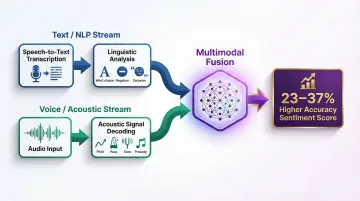
The technology operates through two parallel data streams. Speech-to-text transcription feeds into NLP models that analyze linguistic content, word choice, negation patterns, and even sarcasm detection. Simultaneously, voice analysis decodes acoustic signals like pitch variation, speaking pace, tone shifts, and prosody.
Multimodal fusion of both streams improves accuracy by 23-37% compared to text-only approaches, correctly interpreting phrases like "That's great" when spoken with a flat, frustrated tone.
The cost case for real-time analysis over post-call review is straightforward:
| Approach | Coverage | Cost per Interaction | FCR Impact |
|---|---|---|---|
| Manual QA | 1-3% of calls | $2-$4 | Baseline |
| Automated AI QA | 100% of calls | $0.10-$0.30 | +15-20% first-contact resolution |
Market Context
The Call Center AI market is projected to reach $7.08B by 2030, growing at 23.8% annually. Over 68% of Fortune 500 companies now integrate AI sentiment tools into their CX strategies. Selecting the right tool depends heavily on your use case: sales coaching demands different capabilities than contact center QA or brand monitoring.
11 Best AI Tools for Real-Time Sentiment Analysis in 2026
These tools were selected for real-time processing capability, accuracy, integration depth, and proven value across sales, support, and customer experience teams.
Pifini.ai
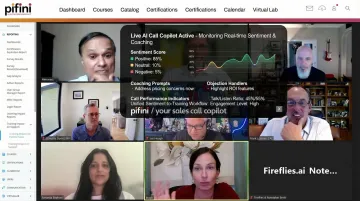
Pifini.ai is an AI-powered revenue enablement platform built specifically for partner sales ecosystems, combining real-time call sentiment scoring with live AI coaching, call analysis, and prescriptive training, all in a single platform at $50/user/year.
Unlike standalone sentiment tools, Pifini closes the loop between sentiment detection and rep improvement by auto-enrolling underperforming reps into targeted training based on call scores, connecting learning directly to revenue outcomes.
The platform delivers real-time feedback on tone, clarity, objection handling, and messaging accuracy during live calls, while automatically scoring every completed call against proven success criteria.
The Live AI Call Copilot surfaces objection handlers, talk track recommendations, and contextual content during customer conversations, while the integrated LMS ensures reps receive immediate training when call scores reveal skill gaps.
| Key Features | Real-time call sentiment scoring, live AI sales coaching during calls, automated training enrollment based on call performance gaps, CRM-synced call scoring, prescriptive learning automation |
| Best For | Channel sales teams, resellers, distributors, and SaaS companies running partner ecosystems who need sentiment tied directly to training and revenue outcomes |
| Pricing | $50/user/year (all-inclusive; verify current pricing on pifini.ai) |
Gong
Gong is a market-leading revenue intelligence platform that analyzes sales calls, emails, and web conferences to surface deal risks, coaching opportunities, and buyer sentiment in near real-time. Its standout capability is topic-level sentiment analysis that tracks emotional shifts around specific conversation themes, pricing, competition, technical concerns, and aggregates these signals into deal health scores that predict at-risk opportunities before they stall. Gong's talk-track analysis reveals which messaging consistently drives positive buyer engagement across your entire revenue organization.
| Key Features | Topic-level sentiment tracking, deal health scoring based on sentiment trends, rep talk-track analysis, AI-powered risk alerts for stalled deals |
| Best For | Mid-to-enterprise B2B sales teams needing comprehensive revenue intelligence tied to forecasting accuracy |
| Pricing | Custom enterprise pricing (quote-based) |
Chorus.ai (by ZoomInfo)
Chorus.ai, now part of ZoomInfo, is a conversation intelligence platform that records and analyzes sales calls and meetings to deliver sentiment signals, rep performance scores, and buyer engagement insights. The 2026 differentiator is deep integration with ZoomInfo's B2B data platform, enabling AI-generated call summaries that contextualize sentiment against firmographic intelligence and buying signals. Moment detection flags critical emotional shifts during calls, while automatic CRM activity logging ensures sentiment data flows into deal records without manual entry.
| Key Features | Meeting sentiment scoring, moment detection for emotional shifts, CRM auto-logging, AI call summaries with ZoomInfo data context |
| Best For | ZoomInfo ecosystem users and large SDR organizations already using ZoomInfo's prospecting data |
| Pricing | ~$8,000/year base (3 seats); available bundled with ZoomInfo packages or standalone |
Kixie
Kixie is an AI-powered communications platform for revenue teams that combines a power dialer with built-in conversation intelligence, delivering real-time sentiment scoring by fusing text analysis with acoustic tone detection. Its differentiator is multimodal sentiment scoring that correctly interprets sarcasm and emotional nuance by analyzing pitch, intensity, pace, and prosody alongside linguistic content. Deep bi-directional CRM sync pushes sentiment scores, churn risk flags, and coaching moments into CRM records within seconds of call completion.
| Key Features | Real-time sentiment scoring (text + voice fusion), live rep alerts on negative sentiment spikes, CRM auto-logging of sentiment scores, customizable keyword weighting |
| Best For | Inside sales and SDR teams needing a dialer + sentiment analysis in one platform for high-volume outbound calling |
| Pricing | Published tiers (Professional, Single-Line, Multi-Line); Conversation Intelligence available as premium add-on |
Level AI
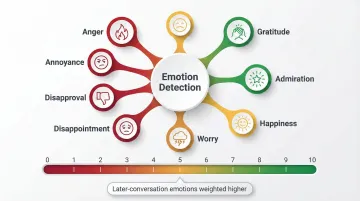
Level AI is a contact center AI platform that delivers automated quality assurance, real-time agent assist, and sentiment analysis across 100% of customer interactions. Its standout capability is detecting eight specific emotions, anger, annoyance, disapproval, disappointment, worry, happiness, admiration, and gratitude, beyond simple positive/negative classification. Level AI assigns a 0-10 weighted sentiment score that emphasizes emotions expressed later in conversations (e.g., after issue resolution), providing more nuanced coaching insights than binary classifications.
| Key Features | Full-interaction sentiment scoring (0-10 scale), real-time manager assist with live call monitoring, sentiment-tagged coaching dashboards, 8-emotion detection taxonomy |
| Best For | Contact centers and customer support teams focused on QA, agent coaching, and Voice of Customer programs requiring granular emotion detection |
| Pricing | Custom enterprise pricing |
Sprinklr
Sprinklr is an enterprise unified CXM platform that applies AI-powered sentiment analysis across social media, digital channels, voice, and chat, making it one of the few tools capable of omnichannel real-time sentiment monitoring at scale. The platform integrates data from 30+ social and digital channels, 400,000+ media sources, and 1 billion+ websites. Sprinklr's 2026 differentiator is real-time anomaly detection that surfaces shifting brand moods in seconds, enabling PR teams to respond to sentiment spikes before they escalate publicly.
| Key Features | Omnichannel sentiment dashboards (30+ channels), AI-driven social listening with anomaly detection, real-time brand sentiment alerts, topic clustering across sources |
| Best For | Enterprise marketing and CX teams monitoring brand sentiment across social and customer support simultaneously |
| Pricing | Custom enterprise pricing tailored for large global brands |
Brandwatch
Brandwatch is a leading consumer intelligence and social listening platform that uses AI to analyze brand mentions, reviews, and conversations across the web in real time, delivering sentiment signals and trend detection before issues escalate publicly. The platform scans 500 million posts daily with Iris AI assistant automatically generating insight summaries that explain the "why" behind trends. Competitor sentiment benchmarking and share-of-voice analysis reveal how your brand's emotional perception compares to competitors in real time.
| Key Features | Real-time social sentiment tracking (500M posts/day), Iris AI-powered trend summaries, share-of-voice competitor benchmarking, automated alerts for negative sentiment spikes |
| Best For | Marketing teams, PR professionals, and brand managers tracking public and social sentiment across global markets |
| Pricing | Custom enterprise pricing |
Qualtrics XM Discover
Qualtrics XM Discover (formerly Clarabridge) is an enterprise Voice of Customer platform that applies AI to analyze unstructured feedback from calls, chat, surveys, and reviews, delivering sentiment, emotion, and effort scoring at scale. The platform aggregates feedback using 150+ industry-specific NLU models and detects intent, emotion, and customer effort in addition to sentiment.
Generative AI summaries and real-time feedback routing based on sentiment enable closed-loop workflows that automatically escalate negative interactions to appropriate teams.
| Key Features | Multi-source sentiment aggregation (calls, chat, surveys, reviews), emotion and effort scoring, feedback-to-action automated workflows, 150+ industry-specific NLU models |
| Best For | Large enterprises running comprehensive VoC programs across multiple feedback channels requiring unified sentiment visibility |
| Pricing | Custom enterprise pricing |
Medallia
Medallia is an enterprise experience management platform that captures and analyzes customer and employee signals, including sentiment from calls, surveys, and digital interactions, to surface actionable insights in real time. The platform's differentiator is AI-driven Root Cause Assist that automatically generates summarized root-cause analyses for sentiment trends, enabling closed-loop feedback automation. Medallia's Experience Data Record (EDR) pricing model does not penalize organizations for high data volumes, making it cost-effective for enterprises analyzing millions of interactions.
| Key Features | Real-time signal capture across touchpoints, AI Root Cause Assist for trend analysis, sentiment-driven alert routing, closed-loop feedback automation |
| Best For | Enterprise organizations running multi-channel CX programs that need sentiment tied to operational KPIs and outcome measurement |
| Pricing | Custom enterprise pricing (EDR model) |
Talkdesk
Talkdesk is a cloud contact center platform with built-in AI tools including real-time sentiment analysis and agent assist capabilities, designed to help support teams intervene during live calls before negative interactions escalate.
Talkdesk Copilot is an AI assistant that listens and guides agents in real time, while the platform's analytics transcribe and analyze 100% of customer interactions to identify topics, intent, and sentiment. The unified CCaaS approach means sentiment analysis integrates natively with call routing, workforce management, and supervisor dashboards.
| Key Features | Real-time agent guidance based on sentiment (Talkdesk Copilot), call transcription + analysis for 100% of interactions, supervisor sentiment dashboards, native CCaaS integration |
| Best For | Mid-market and enterprise contact centers looking for a native sentiment layer within their CCaaS platform without adding third-party tools |
| Pricing | $85–$165/user/month (Copilot and advanced AI features are paid add-ons) |
MonkeyLearn
MonkeyLearn is an NLP-based text analysis platform that enables businesses to build custom sentiment analysis models without deep ML expertise, making it an accessible entry point for teams that need to analyze customer feedback, support tickets, and reviews at scale. The platform offers no-code custom model training with pre-built text classifiers, API access for developer integration, and multi-language support. MonkeyLearn was acquired by Medallia in 2022 but continues operating independently with transparent, credit-based pricing starting at $0/month for testing.
| Key Features | Custom sentiment model training (no-code), pre-built text classifiers for common use cases, API integration for developers, multi-language support |
| Best For | Startups, product teams, and data teams needing a customizable, API-accessible sentiment tool for text-based feedback analysis without enterprise overhead |
| Pricing | $0 to $1,199/month in credit-based tiers |
How We Chose These Tools
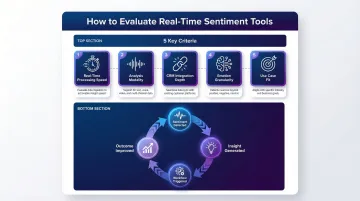
Our evaluation framework prioritized five criteria:
- Real-time processing speed, is sentiment available during or immediately after the interaction?
- Analysis modality, text-only vs. multimodal (text + voice)
- CRM and workflow integration depth, how well scores connect to existing systems
- Emotion detection granularity, beyond basic positive/negative/neutral
- Use case fit, sales, contact center, and brand monitoring requirements
Common buyer mistakes include selecting tools based on brand recognition alone without verifying whether the platform offers true real-time scoring versus post-call batch processing that delivers insights hours later. Many buyers also overlook integration depth, a sentiment tool that doesn't sync scores into your CRM or trigger automated workflows creates data silos rather than actionable intelligence.
Beyond the five core criteria, we weighted pricing transparency, scalability, and whether the tool closes the loop between insight and action, things like automated coaching enrollment, alert routing, and feedback workflows. Tools that detect sentiment but don't trigger downstream actions miss the point entirely: insight without action changes nothing.
Conclusion
The right AI sentiment analysis tool depends entirely on your use case. Sales teams need real-time call scoring wired into coaching workflows and revenue outcomes. Contact centers require 100% interaction coverage with live supervisor alerts. Marketing teams want omnichannel social listening with competitor benchmarking baked in.
Prioritize real-time capability over post-call analysis, integration depth over feature lists, and business outcome alignment over surface-level accuracy claims. Sentiment data is only as valuable as what your team does with it, which means the tool's workflow integrations matter as much as its detection accuracy.
Sales and partner teams that want sentiment insights connected directly to rep performance and training should look at Pifini.ai. It combines real-time call scoring, live AI coaching, and prescriptive learning in one platform, at $50/user/year, compared to $300–$600 with legacy tools like Seismic or Mindtickle. Explore a demo to see how unified sentiment analysis and automated enablement translate into measurable revenue outcomes.
Frequently Asked Questions
How accurate is AI sentiment analysis?
Accuracy varies by approach, multimodal AI systems that fuse text and acoustic analysis typically outperform text-only or rule-based systems, achieving 23-37% higher accuracy. Modern platforms handle clear emotional signals well but still struggle with complex sarcasm or cultural nuance. Human-in-the-loop review remains a best practice for high-stakes decisions.
What AI tools are used for sentiment analysis?
Main categories include sales call intelligence tools (Gong, Kixie, Pifini.ai), contact center platforms (Level AI, Talkdesk), enterprise VoC solutions (Qualtrics, Medallia), and social listening tools (Brandwatch, Sprinklr). The right category depends on where customer interactions happen and whether you need real-time intervention capabilities.
What are the limitations of AI sentiment analysis?
AI handles high-volume, clear-cut sentiment well but struggles with sarcasm, irony, and cultural nuance. Most platforms also lack context about deal history or relationship dynamics, which is why human review remains important for high-stakes decisions like renewal conversations or enterprise negotiations.
What is the difference between real-time and post-call sentiment analysis?
Real-time analysis delivers sentiment scores during live interactions, enabling live coaching and immediate escalation. Post-call analysis processes recordings after the fact, which suits QA and trend reporting. It can't support in-the-moment intervention that prevents churn or salvages at-risk deals.
What is the difference between sentiment analysis and emotion detection?
Sentiment analysis classifies tone as positive, negative, or neutral, while emotion detection identifies specific feelings like anger, frustration, joy, or disappointment. Advanced AI tools now offer both. Emotion detection adds more actionable coaching depth by surfacing the specific feelings driving a customer's response, not just its overall direction.
How does sentiment analysis improve sales performance?
Negative sentiment spikes flagged during live calls let reps adjust messaging on the spot. After the call, scored interactions surface coaching moments for managers, and sentiment trends across deals show which talk tracks and objection handlers consistently move buyers forward, enabling systematic playbook refinement based on what actually works.