Introduction
Modern sales organizations face a crushing reality: reps spend 70% of their time on non-selling tasks, hunting for pitch decks, manually entering CRM notes, and chasing internal approvals, leaving just 30% for actual selling. Meanwhile, 42% of sales reps feel overwhelmed by too many tools, and overwhelmed sellers are 45% less likely to hit quota.
Legacy sales enablement platforms made it worse. They silo training, content, and coaching into separate systems, leaving revenue teams with fragmented data and no visible link between learning and closed deals.
Partner and channel ecosystems take the hardest hit. Most tools ignore resellers and distributors entirely, leaving them without structured onboarding or the product knowledge they need to sell effectively.
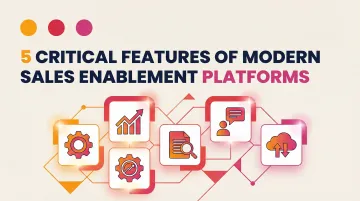
Here are the 5 features that separate modern sales enablement platforms from the tools still holding revenue teams back, and what to insist on before you buy.
Key Takeaways
- Modern platforms unify training, coaching, content, and analytics, not just content libraries
- Live call coaching and adaptive learning paths that auto-enroll struggling reps are now table stakes
- Content surfacing must be contextual, tied to deal stage, persona, and rep performance
- Analytics must connect training to revenue outcomes, not just completion rates
- Modern platforms handle resellers, distributors, and alliances natively, partner ecosystems are too valuable to treat as an afterthought
What Is a Modern Sales Enablement Platform?
A modern sales enablement platform equips every seller, internal and external, with the content, skills, coaching, and data they need to engage buyers effectively and close more deals at every stage of the revenue cycle.
Legacy tools were built as point solutions: a content repository here, a standalone LMS there, maybe a CRM bolt-on for basic analytics. They stored training materials and tracked completion rates, but couldn't connect learning to revenue.
Modern platforms fix that by linking training scores, content usage, and call behavior directly to pipeline outcomes: win rates, deal velocity, and quota attainment.
The definition has expanded for three reasons:
- Buyer expectations have shifted toward personalized, consultative selling
- Partner channels have grown more complex, with resellers and distributors driving a growing share of B2B revenue
- AI now makes real-time coaching and personalized learning paths practical without manual curation
The 5 Critical Features of Modern Sales Enablement Platforms
Feature 1: AI-Powered Sales Coaching and Real-Time Guidance
Modern platforms have moved beyond post-call review. The most advanced tools now provide live AI coaching during customer calls, flagging missed cues, objection signals, and talk-to-listen ratios in real time so reps can adjust on the fly without waiting for a manager debrief.
AI-driven role-play is a critical companion feature. Reps practice against AI buyers in realistic scenarios, discovery calls, objection handling, closing conversations, and receive instant, scored feedback on:
- Tone and emotional quality
- Clarity of messaging and value articulation
- Objection handling effectiveness
- Messaging accuracy against approved playbooks
- Pacing and conversation flow
When gaps are identified, struggling reps are automatically routed into targeted training without manual intervention.
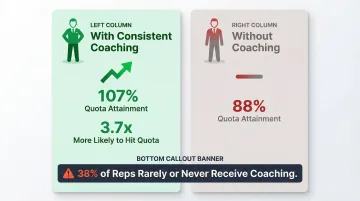
38% of reps say they rarely or never receive coaching, and 14% receive no coaching at all. AI coaching eliminates the manager bottleneck by delivering consistent, data-driven feedback to every rep on every call, not just the ones that happen to get reviewed.
The numbers reflect this directly: reps receiving consistent coaching achieve 107% of quota compared to 88% without it, and sellers who use AI tools are 3.7 times more likely to hit their quota.
Platforms like Pifini.ai take this further by combining live call support, AI role-play, and automated call scoring into a single integrated experience, so every interaction becomes a coaching opportunity without adding to manager workload.
Feature 2: Intelligent Content Management and Contextual Delivery
Centralized content management is a baseline requirement. What separates modern platforms is AI-powered content surfacing that recommends the right asset based on deal stage, buyer persona, product line, and past engagement patterns, removing the manual search burden from reps entirely.
The cost of getting this wrong is significant. Reps spend 31% of their time searching for or creating content, and 60–70% of B2B marketing content goes unused. The result: wasted marketing investment, inconsistent buyer experiences, and reps defaulting to outdated materials.
Modern platforms solve this with intelligent content engines that:
- Surface content based on deal context and buyer engagement history
- Track which assets actually drive deals forward versus which collect digital dust
- Provide usage analytics that inform marketing teams on content ROI
- Deliver 30–80% better performance across clicks, engagement, and customer lifetime value through personalized, relevant interactions
Governance features are equally important: version control, content expiration flags, compliance controls, and permissions management ensure sensitive materials reach the right stakeholders without exposing organizations to risk.
Feature 3: Adaptive Learning, Onboarding, and Prescriptive Training
Modern platforms have shifted from static, one-size-fits-all training to adaptive learning paths that assess each rep's current skill level, role, and performance data to build personalized learning journeys, and auto-enroll users into targeted modules when assessment data signals a gap.
A modern LMS capability inside an enablement platform includes:
- Microlearning formats that slot into a seller's active workflow
- Gamification mechanics that drive completion and sustained engagement
- Video-based assessments and realistic practice simulations
- Certification tracking with automated expiration alerts
- Prescriptive automation that routes struggling users into targeted courses based on call scores or role-play results
Platforms that bundle enterprise LMS natively avoid the hidden costs and integration friction of bolt-on solutions.
Onboarding speed has direct revenue consequences. Average SDR ramp time is 3.1 months, and AE ramp averages 4–8 months. Every week of delay drains productivity and pipeline. Modern platforms compress ramp time by combining structured learning paths, role-play practice, and curated content assets from day one.
Losing one SDR costs $115,000–$195,000 when you factor in replacement, lost pipeline, ramp time, and team drag. Faster onboarding directly impacts revenue.
Sales organizations that use an adaptive approach are three times more likely to grow, according to Gartner.
Feature 4: Revenue-Connected Analytics and Performance Measurement
Analytics in a modern enablement platform must go beyond completion rates and login activity. The key is connecting training scores, content usage, and coaching outcomes to actual business metrics: win rates, deal velocity, quota attainment, and pipeline growth.
Meaningful dashboards layer multiple data streams:
- Rep scorecards combining learning behavior, call performance, and content usage with pipeline data
- Manager views surfacing which reps need coaching intervention and which training modules correlate with wins
- Executive views that quantify enablement ROI in revenue terms, not activity counts
Conversation intelligence adds a critical analytics layer. AI analyzes sales calls for patterns, which talk tracks correlate with wins, where deals stall, what objections signal churn risk, and feeds those insights back into training and coaching programs automatically.
Results from integrated deployments bear this out. When enablement technologies were connected to CRM, quota attainment ran 6.8% above average. Adding conversation intelligence raised close rates by 7.4% and cut time to quota by 3 weeks.
By 2029, sales organizations with AI-driven enablement will achieve 40% faster sales stage velocity than those using traditional approaches, according to Gartner.
Feature 5: Partner and Channel Ecosystem Enablement
Partner enablement is the most underserved capability in legacy platforms. Most tools are built exclusively for direct sales teams, leaving resellers, distributors, and alliance partners with no structured onboarding, inconsistent product knowledge, and no visibility into their performance.
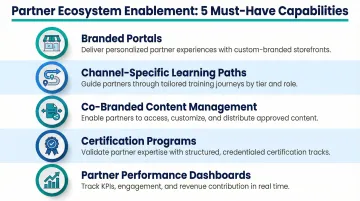
Modern platforms built for partner ecosystems require:
- Branded portals that deliver a customized experience for external users
- Channel-specific learning paths tailored to reseller roles, product lines, and certification requirements
- Co-branded content management so partners can share approved materials with their customers
- Certification programs with automated tracking and expiration alerts
- Partner performance dashboards that connect training completion to partner-sourced pipeline and revenue
The scale of the opportunity makes this non-negotiable. 67% of B2B partner and channel marketing decision-makers expect indirect revenue to grow above last year's levels. Sales through the IT distribution channel reached a record $24.3 billion in Q4 2025 in North America alone.
More educated partners mean:
- Fewer support escalations and product knowledge gaps
- Faster time-to-first-deal for newly onboarded resellers
- Measurable improvements in partner-sourced revenue and deal registration rates
- Higher partner retention and engagement
Pifini.ai was built around this reality from the ground up, with dedicated portals, channel-specific learning paths, and partner performance dashboards designed for resellers, distributors, and alliances rather than retrofitted from a direct-sales tool.
What Separates Modern Platforms from Legacy Tools
Legacy tools were built as point solutions, a standalone LMS here, a content repository there, a CRM bolt-on for analytics. Modern platforms unify all of these into a single data environment, so every training action, content interaction, and coaching moment is connected and measurable.
Organizations that assemble multiple point solutions often pay more than they realize once licensing, integration, and administration costs are stacked, while still getting fragmented data and low adoption. By the end of 2025, more than 70% of B2B companies will use dedicated sales enablement platforms, compared to only 34% in 2021.
Companies using integrated platforms reduce data inconsistencies by 64% and increase forecasting accuracy by 26%.
Underused or unused marketing content costs enterprises approximately $2.3 million annually in missed opportunities. Enablement platforms surface the right content and retire what doesn't work, reducing this waste at the source.
That content goes unused for a reason: sellers can't find it, don't trust it, or aren't trained on it. Adoption is what determines whether any of this delivers ROI. Modern platforms earn it through:
- Intuitive, mobile-first UX that reps actually choose to engage with
- Workflow integration that embeds enablement into existing sales processes
- Real-time value delivery, not just training completion, but actionable insights during live calls
77% of sellers struggle to complete their assigned tasks efficiently, despite investments in sales technologies. They have tools. They just have too many disconnected ones.
Conclusion
The five features, AI coaching, intelligent content delivery, adaptive learning, revenue analytics, and partner enablement, form an interconnected system, not isolated capabilities. Each one amplifies the others: AI coaching identifies gaps that trigger adaptive learning, which surfaces content at the right moment, which feeds engagement data into revenue analytics.
That chain only delivers full value when it scales across both internal teams and external partner ecosystems without breaking down at the edges.
When evaluating platforms, go beyond feature checklists. Ask how each capability connects to measurable revenue outcomes, and whether the platform covers partners and resellers natively, or charges add-on costs to get there.
Pifini.ai is built as an all-in-one revenue enablement platform that delivers all five of these capabilities, including live AI coaching, an enterprise LMS, partner-first design, and revenue-tied analytics, at $50/user/year. That's roughly 10x less than Seismic, Bigtincan, or Mindtickle, with no modules gated behind higher tiers. Explore a demo to see how a unified platform closes the loop from call coaching to partner certification to closed revenue.
Frequently Asked Questions
What does a sales enablement platform do?
A sales enablement platform equips sales reps with the content, training, coaching, and data needed to engage buyers effectively and close more deals. Modern platforms connect those activities directly to revenue outcomes, win rates, deal velocity, and quota attainment, rather than just tracking completion rates.
What is the difference between a sales enablement platform and a CRM?
A CRM manages customer data and pipeline tracking, while a sales enablement platform equips reps with the skills, content, and coaching needed to act on that pipeline. The best modern platforms integrate directly with CRM systems to connect learning and enablement activities to deal outcomes.
How does AI improve sales enablement?
AI personalizes learning paths based on each rep's skill gaps, surfaces the right content at the right deal stage, and scores role-plays automatically. It also provides in-call and post-call coaching feedback, then links all activity to revenue metrics so managers can act on data rather than instinct.
How do sales enablement platforms support channel partners and resellers?
Platforms built for partners offer branded portals, channel-specific training paths, certification programs, and co-branded content libraries. Partner performance dashboards tie learning completion to partner-sourced revenue, giving resellers and distributors the same structured enablement as internal teams.
How do you measure the ROI of a sales enablement platform?
Core metrics are rep ramp time, quota attainment, win rate changes, and content usage correlated with deal outcomes. Platforms with built-in revenue analytics surface these connections automatically, removing the need for manual reporting.
What should you look for when choosing a sales enablement platform?
Prioritize platforms that unify training, content, coaching, and analytics in one system; offer AI-native capabilities like live call coaching and adaptive learning; support partner ecosystems natively; integrate with existing CRM and PRM systems; and deliver transparent pricing without costly add-ons or hidden fees.