

Introduction
B2B buying has changed. The average deal now involves 13 internal stakeholders and nine external influencers, according to Forrester's 2026 research. Sales cycles have stretched to 6.5 months in 2023, up from 4.9 months in 2019. 6sense data adds another layer: 69% of the purchase process happens before buyers engage with sellers, with 81% choosing a preferred vendor before speaking with sales.
Scattered emails and one-off attachments can't keep pace with that reality. Buyers moving through fragmented touchpoints lose momentum; sellers without visibility into buyer behavior can't engage at the right moment.
Digital sales rooms solve both problems by centralizing deal content, collaboration, and next steps in one secure workspace. Sellers get the engagement signals they need. Buyers get the organized experience they expect.
This article covers what digital sales rooms are, the features that drive their effectiveness in complex B2B deals, and the measurable benefits they deliver in day-to-day deal management.
Key Takeaways
- A digital sales room is a secure, centralized workspace where sellers and buyers collaborate on content, communication, and next steps
- Core features include content hubs, buyer engagement analytics, mutual action plans, personalization, and CRM integrations
- Key benefits include shorter sales cycles, stronger multi-stakeholder alignment, and real-time visibility into buyer intent
- DSRs deliver the highest impact in complex B2B deals where multiple stakeholders and extended evaluation periods slow momentum
- Without a DSR, fragmented buyer experiences stall deal velocity and leave sellers blind to where deals actually stand
What Is a Digital Sales Room?
A digital sales room is a branded, secure online workspace where sellers share proposals, content, and resources, and buyers access everything they need to evaluate and decide, all in one place.
That definition covers the basics, but DSRs fit into more stages than most teams realize. They're built primarily for active deal management, replacing fragmented email threads and shared folders with a single, organized hub. Their reach extends further: sales teams deploy them for pre-sales outreach, customer onboarding, renewals, and channel partner enablement. Anywhere a buying process involves multiple touchpoints, stakeholders, and content exchanges, a DSR provides structure.
Core Components of a Digital Sales Room
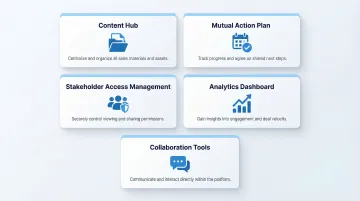
Most platforms include these standard building blocks:
- Content hub - Centralized repository for proposals, decks, case studies, pricing, and contracts
- Mutual action plan - Shared timeline of milestones, tasks, and responsibilities visible to both buyer and seller
- Stakeholder access management - Controls showing which contacts have accessed the room and what they viewed
- Analytics dashboard - Engagement tracking showing content views, time on page, downloads, and new stakeholder activity
- Collaboration tools - Built-in chat, comments, and async video for buyer-seller communication
How DSRs Differ from Email and Shared Folders
| Dimension | Email & Folders | Digital Sales Room |
|---|---|---|
| Content organization | Scattered across threads | Centralized in one hub |
| Version control | Confusion from outdated attachments | Buyers always see latest content |
| Buyer visibility | Sellers guess who's engaged | Contact-level analytics |
| Professional experience | Generic, fragmented | Branded, dedicated workspace |
Must-Have Features of a Digital Sales Room
The most effective DSRs are not just document libraries, they are structured around features that actively move deals forward and provide sellers with actionable intelligence.
Centralized Content Hub
A content hub lets sellers upload, organize, and share all deal materials, proposals, case studies, pricing, demos, in one branded space that buyers can access without hunting through email threads. Instead of sending attachments that get buried in overcrowded inboxes, sellers direct buyers to a single URL where everything lives.
Version control is critical: buyers always see the latest content, eliminating confusion from outdated attachments. When sellers update pricing or revise a proposal, the change appears instantly in the room, with no need to resend files or risk buyers reviewing stale information.
Buyer Engagement Analytics and Intent Signals
Analytics track contact-level engagement: which stakeholders viewed which content, for how long, what they downloaded, and when new stakeholders entered the room. This transforms seller follow-up from calendar-based guesswork to signal-driven precision.
That precision depends on timing. Research shows that leads contacted within 5 minutes are 21x more likely to be qualified than those contacted after 30 minutes, yet the average B2B lead response time is 42 hours. Real-time DSR alerts close this gap, notifying sellers the moment a CFO opens the pricing deck or a new stakeholder enters the room, enabling outreach that's both timely and relevant.
Mutual Action Plans and Deal Milestones
A mutual action plan is a shared timeline of tasks, milestones, and responsibilities visible to both buyer and seller, creating accountability on both sides and reducing "we'll get back to you" limbo. Instead of sellers pushing unilaterally for next steps, both parties agree to specific dates and owners for actions like internal demos, legal reviews, or budget approvals.
74% of B2B buyer teams demonstrate unhealthy conflict during the decision process, according to Gartner. Conflict occurs when team members have conflicting objectives, disagree on the best course of action, or are overruled by external decision-makers.
Visible milestones reduce this friction by creating a shared source of truth. Everyone on the buying team sees the same timeline and progress, which minimizes internal misalignment and keeps deals moving.
Personalization and White-Labeling
The best DSR platforms allow sellers to customize rooms with brand colors, logos, and account-specific content, making each room feel purpose-built for that buyer rather than generic. A branded, professional space signals preparation and seriousness, a real differentiator when buyers are evaluating multiple vendors simultaneously.
Personalization extends beyond visual branding. Sellers curate content specific to the buyer's industry, use case, and deal stage, surfacing only the most relevant case studies, objection-handling assets, and competitive differentiators. This focus reduces buyer overwhelm and increases engagement.
CRM and Tech Stack Integrations
Native CRM integrations (Salesforce, HubSpot) ensure engagement data flows automatically into deal records, keeping forecasts accurate without manual logging. When a prospect views the pricing page three times in one day, that signal surfaces in the CRM opportunity record, giving managers objective deal-health data rather than relying solely on rep self-reporting.
Beyond the CRM, integrations across the tech stack enable:
- Automated alerts when buyers engage, triggered directly to the responsible rep
- Follow-up sequences launched based on specific buyer actions in the room
- Pipeline visibility pulled from DSR activity into revenue dashboards
This creates a connected workflow where buyer intelligence drives action across systems, not just within the DSR itself.
Key Benefits of Digital Sales Rooms for B2B Sales
The features above translate into three operational advantages that directly impact the metrics sales leaders track, deal velocity, stakeholder alignment, and pipeline visibility.
Benefit 1: Accelerated Deal Velocity
DSRs eliminate the back-and-forth friction of scattered emails and multiple document threads, giving buyers a single place to access everything they need to evaluate and decide. By consolidating content, next steps, and communication in one branded space, buyers move through evaluation stages faster. Internal champions can share the room with colleagues without waiting for a rep, no more requests for materials buried in inboxes.
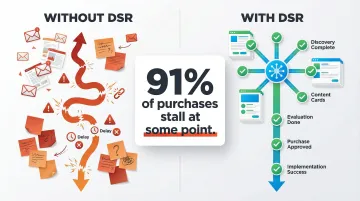
Each time a buyer has to locate an old email or chase a follow-up, momentum stalls. DSRs remove these micro-delays and compress time-to-decision. Forrester research shows that 91% of purchases stall at some point, with "my organization's purchasing process" ranking as the third-most cited reason. On-demand, organized access to materials directly addresses that friction.
A shorter sales cycle means lower cost of sale and faster revenue recognition. Gartner notes that CSOs who deploy digital sales rooms early can streamline discovery and facilitate buying group consensus, leading to faster sales cycles and higher win rates. This benefit hits hardest for deals with 30+ day cycles or multiple evaluation stages where consensus-building slows progress.
KPIs impacted:
- Sales cycle length
- Time-to-close
- Deal conversion rate
- Content reuse rate
Benefit 2: Multi-Stakeholder Alignment and Champion Enablement
B2B buying decisions involve committees, multiple stakeholders across functions, and DSRs give sellers visibility into who is engaged while giving buyer-side champions the tools to sell internally.
Stakeholder access management shows which personas have viewed the room. Analytics surface gaps: if finance hasn't accessed the ROI deck, sellers know to proactively engage that stakeholder before it becomes a late-stage objection. Mutual action plans create shared accountability across the buying team, reducing the risk that unanswered questions derail deals late in the process.
Deals stall most often not because the primary contact lost interest, but because unseen stakeholders, finance, IT, legal, have questions no one addressed. Gartner found that buying groups that reach consensus are 2.5 times more likely to report that their deal was high-quality. Meanwhile, procurement professionals are decision-makers in 53% of business buying cycles, often scrutinizing far more than price. Champions equipped with a well-organized DSR can share materials internally without waiting for a rep, accelerating consensus without adding sales-rep hours.
This benefit is most critical for enterprise deals, complex solution sales, and channel/partner-led selling where reps have limited visibility into the customer's internal dynamics.
KPIs impacted:
- Win rate
- Deal size
- Stakeholder engagement rate
- Champion activation rate
Benefit 3: Real-Time Buyer Engagement Visibility
Traditional sales follow-up relies on intuition and calendar. DSRs replace guesswork with data, showing reps exactly what buyers are reviewing and when to act.
Analytics dashboards surface intent signals: a prospect revisiting the pricing page, a new stakeholder entering the room, a champion sharing materials with a colleague. Each signal indicates deal progress, or risk. This data enables sellers to follow up with context: "I noticed you reviewed the security documentation, do you have questions for our compliance team?"
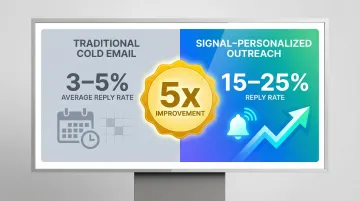
Sellers who follow up based on actual buyer behavior are more relevant and timely than those working off fixed schedules. Research shows that signal-personalized outreach achieves 15–25% reply rates, compared to the 3–5% industry average for cold email, a 5x improvement.
For managers, DSR analytics provide objective deal-health signals rather than rep self-reporting alone. That matters in an environment where 79% of sales organizations miss their sales forecast by more than 10%, and 4 in 5 sales and finance leaders have missed a forecast in the past year. This benefit is most valuable for complex deals with long silences between buyer interactions, where engagement data separates live opportunities from stalled ones.
KPIs impacted:
- Pipeline accuracy
- Forecast reliability
- Follow-up response rate
- Buyer engagement score
What Happens Without a Digital Sales Room
Without a DSR, proposals live in email threads, content versions get confused, and sellers have no visibility into whether buyers are actively engaged or have gone cold. The primary contact says "we're still evaluating," but there's no way to know if that means active internal discussion or complete radio silence.
The consequences compound:
- Deal momentum stalls as buyers wait for materials or can't find what they need
- Sellers over- or under-follow-up because they're guessing at buyer engagement with no signal to act on
- Buying committees get misaligned due to fragmented information, different stakeholders reviewing different versions of proposals
- Win rates suffer as competitors who offer a cleaner, more consistent buying experience close deals faster
These issues don't stay contained to individual deals. As volume grows, reps spend increasing time on admin rather than selling, and onboarding new reps into active deals becomes chaotic when deal history is scattered across inboxes. A single lost deal might be survivable; a broken process repeated across every rep and every quarter is not.
How to Get the Most Value from Your Digital Sales Room
A DSR only delivers its benefits when it becomes the default channel, sellers must train buyers to use it as the central hub from first follow-up onward, rather than sending attachments alongside it. When sellers email PDFs "just in case," buyers revert to old habits and the DSR becomes a ghost town.
Once buyers are reliably using the room, what's inside it matters just as much. A few best practices that make a measurable difference:
- Populate rooms with only stage-appropriate content, overcrowded rooms overwhelm prospects and dilute intent signals
- A focused DSR with six relevant assets generates cleaner engagement data than one cluttered with thirty generic pieces
- Audit room content at each deal stage and remove anything that no longer matches where the buyer is in their decision process
The real competitive advantage comes when DSR engagement data feeds directly into seller coaching. When a seller sees that buyers consistently disengage at a specific content piece or deal stage, that pattern should trigger targeted training, not just a note in a CRM.
Pifini connects buyer engagement data to AI-driven coaching and rep enablement, so disengagement signals automatically surface the right training rather than getting buried in a dashboard no one checks.
Frequently Asked Questions
What is a digital sales room?
A digital sales room is a secure, branded online workspace where sellers share deal content and buyers access proposals, case studies, and pricing in one place. It replaces scattered email threads and gives sellers real-time visibility into how buyers engage with content.
What features should I look for in a DSR platform?
Evaluate platforms on: centralized content libraries, branded buyer workspaces, mutual action plans, engagement analytics, and AI coaching tools. The strongest platforms, including options like Pifini, combine these into a single system rather than requiring separate tools for each function.
How much does Showpad cost?
Showpad does not publish pricing publicly and requires a custom quote. DSR platform pricing varies widely. Lightweight tools offer freemium tiers, while full-featured enablement platforms with advanced analytics typically run hundreds of dollars per user per year, though newer entrants like Pifini price as low as $50/user/year.
What companies use Showpad?
Showpad is used by mid-market and enterprise B2B sales teams across industries like technology, manufacturing, healthcare, and financial services. DSR adoption broadly spans companies where long sales cycles and multi-stakeholder deals are the norm, enterprise software, industrial equipment, and complex service providers.
How do you stay on top of trends in sales and sales enablement?
Practitioner communities, analyst reports from Gartner and Forrester, and enablement platforms that surface performance data directly. The trend worth watching in 2025 is AI-guided coaching that ties sales training to actual revenue outcomes, not just completion rates.