Introduction
B2B selling has gotten measurably harder. Sales cycles have grown 16% longer, now averaging 6.5 months compared to 4.9 months in 2019, and 57% of sales professionals report that the cycle keeps lengthening. Meanwhile, sellers spend 70% of their time on non-selling tasks, leaving just 30% for actual selling.
Most teams respond with fragmented tools, static content libraries, and periodic training sessions that can't keep pace with how fast buyers and markets move.
AI sales enablement changes that equation. Rather than bolting AI onto existing workflows, leading revenue teams are using it to fundamentally rethink how sellers prepare, engage buyers, and close deals, from first outreach through renewal.
Key Takeaways
- Sellers spend just 30% of their day in actual selling conversations, AI automates administrative tasks to reclaim that time
- Real-time coaching and conversation intelligence improve performance on every call, not just during scheduled training sessions
- AI surfaces the right content and messaging for each deal stage and buyer context, without reps having to search for it
- For channel organizations, AI enablement closes the partner readiness gap that legacy LMS platforms consistently fail to address
- Unified platforms replace siloed point solutions, cutting costs while connecting training, content, coaching, and analytics in one place
What AI Sales Enablement Is (and Why B2B Teams Can't Afford to Wait)
AI sales enablement uses machine learning, generative AI, and automation to equip sellers, partners, and managers with the right training, content, and guidance, delivered in context and in real time, to improve performance across every stage of the revenue cycle.
Gartner defines revenue enablement platforms as systems that unite sales and customer-facing functions, with capabilities spanning digital content, learning, practice and coaching, engagement analytics, AI, and conversational intelligence for skill building.
Why Traditional Enablement No Longer Works
Traditional sales enablement relies on static content libraries, periodic training sessions, and manual coaching reviews. These approaches fall short when buyers expect personalized, informed interactions at every touchpoint. Consider the scale of the problem:
- Up to 70% of B2B marketing content goes unused by sales teams
- 84% of new knowledge learned in sales training is lost after 90 days
- Sellers spend only 30% of their day actually selling
When content sits unused and training evaporates within weeks, static enablement stops being a performance driver. It becomes a cost center.
The Competitive Risk of Waiting
The urgency is measurable. 81% of sales teams are currently investing in or experimenting with AI, and the performance gap is widening fast:
- Teams using AI report 83% revenue growth vs. 66% for non-adopters, a 17-point gap that widens with every sales cycle.
- Gartner predicts that by 2029, sales organizations with AI-driven enablement will achieve 40% faster sales stage velocity than those using traditional approaches.
For organizations that haven't yet adopted AI enablement, the question is no longer whether to act, it's whether there's still time to close the gap before it becomes structural.
How AI Is Transforming Every Stage of the B2B Sales Process
AI sales enablement doesn't optimize just one moment in the sales cycle. Its real power emerges when it supports every stage, from prospecting and discovery through proposal, negotiation, close, and renewal. As Bain & Company explains, "One use case rarely moves the needle because a seller's day is fragmented across dozens of tasks... the secret to significant gains lies in reimagining sales processes rather than just automating existing ones."
Addressing only one stage produces marginal gains. What follows breaks down where that end-to-end impact actually shows up.
Real-Time Coaching and Conversation Intelligence
AI-powered conversation intelligence automatically records, transcribes, and analyzes every call for key signals: objection patterns, competitor mentions, buyer sentiment, and talk-to-listen ratios. This gives managers and reps actionable feedback without manual review.
How it works in practice:
- Every sales call is automatically transcribed and evaluated against proven success criteria
- The platform identifies specific performance gaps, weak discovery, missed objection handling, poor product positioning, or ineffective closing techniques
- Feedback is delivered immediately after the call while context is fresh
- Managers receive AI-generated summaries highlighting patterns across their team, eliminating hours of manual call review
Why timing matters: Research shows that optimal feedback spacing produces a 64% increase in final recall and a 26% increase in recognition. Immediate post-call feedback outperforms coaching delivered in a scheduled session days later, when the detail has already faded.
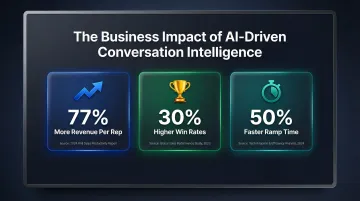
The business impact is measurable: AI-driven teams generate 77% more revenue per representative, while conversation intelligence platforms facilitate a 30% increase in win rates and 50% reduction in ramp time for new reps.
AI-Powered Content Delivery and Personalization
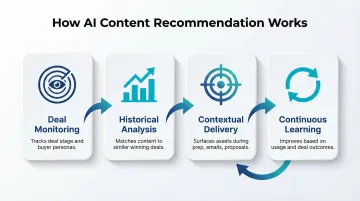
AI content recommendation engines analyze deal stage, buyer role, industry vertical, and historical performance to surface the right asset, whether a battlecard, case study, or demo script, at precisely the moment a rep needs it. This eliminates the manual search and guesswork that causes content to go unused.
How AI recommendation works:
- The platform monitors where each deal sits in the sales cycle and which buyer personas are engaged
- It analyzes which content has historically performed best for similar deals, industries, and buyer types
- Recommendations appear in context, during call prep, follow-up email drafting, or proposal assembly
- The system learns from usage patterns, continuously improving recommendations based on what actually drives deals forward
Gartner predicts that by 2027, 95% of seller research workflows will begin with AI. That shift means reps who use AI-driven content tools can tailor messaging for each deal without building every asset from scratch.
Generative AI is extending this further into content creation itself:
- Automated follow-up email drafts that incorporate key points from the previous call
- Dynamic presentation assembly that pulls relevant slides based on buyer role and deal stage
- Personalized outreach at scale that maintains message consistency across the team
The result: reps spend less time on prep work and more time in front of buyers, with better materials than they'd assemble manually.
AI Sales Enablement for Partner and Channel Teams
Partner and channel sales present a unique challenge. Unlike direct sellers who sit inside your organization and receive daily coaching, channel partners, resellers, distributors, and alliances, operate independently, manage multiple vendor lines, and rarely receive the same level of training investment as your internal team. This creates a massive, measurable performance gap.
The Partner Readiness Gap
The data is stark: Partners who complete certification programs earn 6x more revenue than those who skip training, and partner-attributed deals have a 2.8x higher win rate and are 32% larger than direct-only deals. Yet program adoption by partners can be as low as 20%.
Traditional partner enablement relies on static portals, optional training, and manual follow-up from channel managers who spend 80% of their day answering repetitive questions. AI changes this equation fundamentally.
How AI Closes the Partner Readiness Gap
Intelligent LMS platforms auto-enroll partners into targeted training modules based on their performance data, certification status, or deal stage activity, rather than relying on partners to self-direct their learning. When a partner shows gaps in product knowledge or objection handling, the system automatically routes them into prescriptive courses designed to close those specific gaps.
Engagement tools keep participation high:
- Microlearning modules that automatically transform campaign materials into short, interactive experiences
- AI-driven simulations and role-play tools that make enablement feel like practical skill-building, not compliance training
- Personalized learning journeys that deliver content on-demand when partners need it
The engagement impact is measurable. Partners using modern AI enablement platforms report 30% higher program engagement and 40% faster training completion.

Connecting Partner Training to Deal Performance
The real transformation happens when partner training outcomes connect directly to deal data. When you can show that certified partners close deals at a higher rate, win more competitive bids, or generate fewer support escalations, training becomes a measurable revenue lever, not an overhead cost.
Pifini.ai unifies partner LMS, AI coaching, content, and deal analytics in one platform, connecting enablement investment directly to pipeline outcomes. Its Training Impact Analysis module ties training completions, coaching scores, and certifications to:
- Win rates and deal velocity
- Quota attainment by partner tier
- Competitive bid performance over time
The link between certification and revenue is well-documented across the industry. Red Hat certified software products generated 49% higher revenue and a 19% improvement in win rates compared to uncertified products, a pattern that holds across partner ecosystems when training is tied to measurable outcomes.
The Scale and Cost Challenge
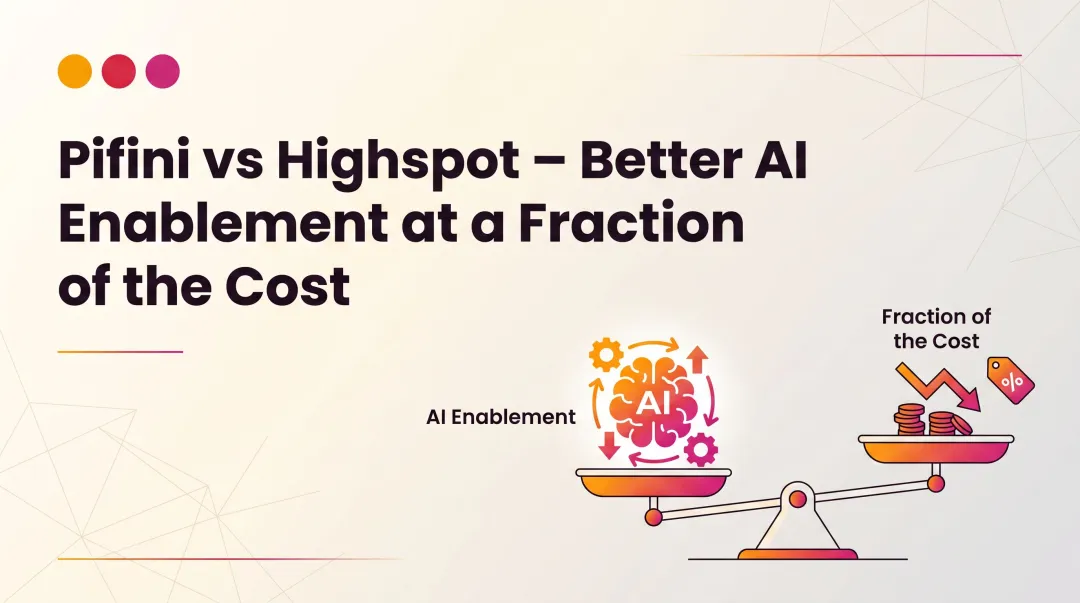
Most enterprise partner enablement platforms carry per-user costs that make broad partner network coverage prohibitive. AI-first platforms are changing this economics. Pifini.ai delivers enterprise-grade capabilities, including LMS, AI coaching, Digital Sales Rooms, and buyer engagement tools, at $50 per user per year, compared to $300–$600 per user with legacy competitors like Seismic or Mindtickle. This pricing model makes it practical to extend quality enablement to every tier of your partner ecosystem.
Connecting AI Enablement to Measurable Revenue Outcomes
The historical gap in sales enablement has always been proving ROI. Training, content usage, and coaching lived in separate systems, disconnected from CRM pipeline data. AI platforms close this loop by correlating enablement activities, training completions, content shares, coaching scores, directly to win rates, deal velocity, and quota attainment.
The Forecasting Advantage
AI that ingests both rep behavior data and buyer engagement signals produces more accurate pipeline forecasts than those based purely on CRM stage updates or rep-reported confidence levels. Buyer engagement signals include:
- Content views and time spent in shared sales materials
- Meeting attendance and stakeholder participation patterns
- Questions asked and topics explored in Digital Sales Rooms
AI/ML-assisted forecasting delivers a 15-25% improvement over manual methods, achieving ±8-15% variance. A Forrester study for Clari showed forecast accuracy improved from 8–9% variance to 5–6% variance, significantly reducing pipeline uncertainty.
Prescriptive Analytics in Practice
AI enablement platforms go beyond lagging indicators. They identify which reps have skill gaps tied to upcoming deal stages and automatically prescribe the right training, before the rep loses the deal.
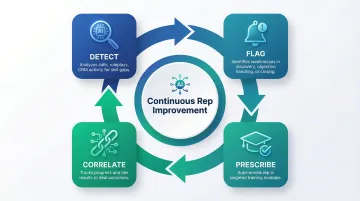
- The system analyzes call recordings, roleplay performance, and CRM activity to detect skill gaps
- When a rep shows weakness in discovery, objection handling, or closing, the platform flags the gap
- The rep is automatically enrolled in targeted modules addressing that specific deficiency
- Progress is tracked and correlated to deal outcomes, creating a continuous improvement loop
The results show up in ramp metrics. CentiMark reduced new seller ramp time to just 8 days using structured onboarding and Call AI. Janssen India cut rep ramp time by 50% and saw a 35% increase in sales within a new rep's first six months.
The Manager Leverage Point
AI changes the math for frontline managers who currently spend hours reviewing call recordings or chasing participation reports. The time savings are concrete:
- AI automates 30% of sales admin tasks, saving 20 hours per rep weekly
- A Forrester study found a 50% reduction in admin tasks overall
- One VP reported a 90% reduction in forecast rollup time, from 4 hours a week to 1 hour
With AI-summarized coaching insights, managers redirect 1:1 time toward high-impact conversations. The result: broader team coverage without adding hours to the calendar.
What to Look for in an AI Sales Enablement Platform
Not all AI sales enablement platforms deliver the same value. Revenue leaders should apply three critical evaluation criteria:
Integration Depth
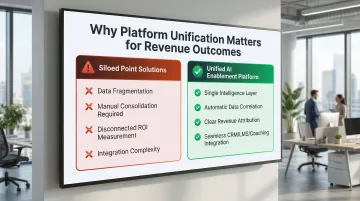
The platform should unify data from CRM, PRM, learning management, and conversation intelligence into a single intelligence layer, not just connect to those systems at the surface level. Without that depth, you end up with data silos that undermine ROI measurement and create manual reconciliation work.
AI Capability Authenticity
Basic automation relabeled as AI is common, the real differentiator is whether the system improves over time. Genuine AI enablement platforms:
- Analyze historical content performance to recommend the right assets for each deal stage and buyer type
- Learn from call patterns to identify skill gaps and prescribe targeted training
- Continuously improve recommendations based on what actually drives deals forward
Ask vendors for specific examples of how their AI adapts to your organization's unique sales motion and whether the system improves with use.
Unified vs. Point Solution
Platforms that unify content, training, coaching, and analytics in one place eliminate the data fragmentation that undermines ROI measurement. Siloed point solutions create integration headaches, require manual data consolidation, and make it impossible to connect enablement activities to revenue outcomes.
Recent analyst evaluations reinforce this. Forrester's evaluation across 32 criteria prioritizes unified user experiences, substantive AI capabilities, and measurable revenue management. Gartner's Magic Quadrant scores vendors on "Ability to Execute" and "Completeness of Vision," with growing emphasis on agentic AI and ROI-focused outcomes.
Partner-First Design
Channel organizations need a platform built for partners from the ground up, not one that treats partner access as an afterthought. Evaluate whether the UX, onboarding flows, and learning paths are designed for external users who log in occasionally, not internal reps with daily access.
Key partner-first features include:
- Simplified, intuitive interface requiring minimal onboarding
- AI-powered self-service support (reducing dependency on channel managers for routine questions)
- Multi-vendor program consolidation (since partners represent multiple vendors simultaneously)
- Affordable pricing that makes ecosystem-wide deployment practical
Pifini.ai is built specifically for partner-first organizations, combining LMS, AI coaching, and buyer engagement tools in a single platform at $50 per user per year, compared to the $300–$600 per user that legacy competitors like Seismic, Bigtincan, and Mindtickle charge.
Proving ROI from Day One
Before shortlisting any platform, ask vendors how they connect enablement activity to revenue outcomes, not just in theory, but in the data:
- How do you link training completions and content usage to pipeline data?
- Can you show win rate changes correlated to certification completion?
- How do you measure ramp time reduction and quota attainment improvement?
The platform should offer dashboards that display expected versus actual performance, validating whether training investments deliver the promised pipeline and quota improvements.
Frequently Asked Questions
What is AI sales enablement?
AI sales enablement uses machine learning, automation, and generative AI to equip sales teams and partners with real-time coaching, personalized content, and data-driven guidance. It delivers the right training and assets at exactly the right moment, moving the revenue cycle from reactive to intelligent.
How is AI sales enablement different from traditional sales enablement?
Traditional enablement offers static content libraries and periodic training sessions. AI enablement delivers personalized, context-aware guidance in real time, analyzing call performance, recommending content by deal stage, and automatically routing reps into training based on where they're struggling. The shift is from reactive to proactive, from generic to personalized.
Can AI sales enablement work for partner and channel sales teams?
Yes, AI enablement is especially valuable for partner ecosystems because it auto-enrolls partners in targeted training, delivers just-in-time content without requiring partners to navigate complex portals, and ties partner certification data directly to deal performance metrics. This closes the readiness gap that traditional partner programs leave open.
What results can B2B sales teams expect from AI sales enablement?
Organizations typically report faster rep ramp times (30–50% reduction), improved quota attainment, shorter sales cycles, and more accurate forecasting. Results vary by deployment maturity, but pipeline impact is typically visible within the first two quarters.
How should sales leaders measure the ROI of AI sales enablement?
Connect enablement activities, training completions, coaching scores, content usage, to pipeline metrics like win rates, deal velocity, and quota attainment. Native CRM integration makes this correlation straightforward, turning learning data into revenue evidence.
Is AI replacing sales reps and partner managers?
No, AI augments rather than replaces human sellers. It removes administrative overhead and surfaces better insights, but the judgment, relationship-building, and trust that drive B2B deals still require human expertise.